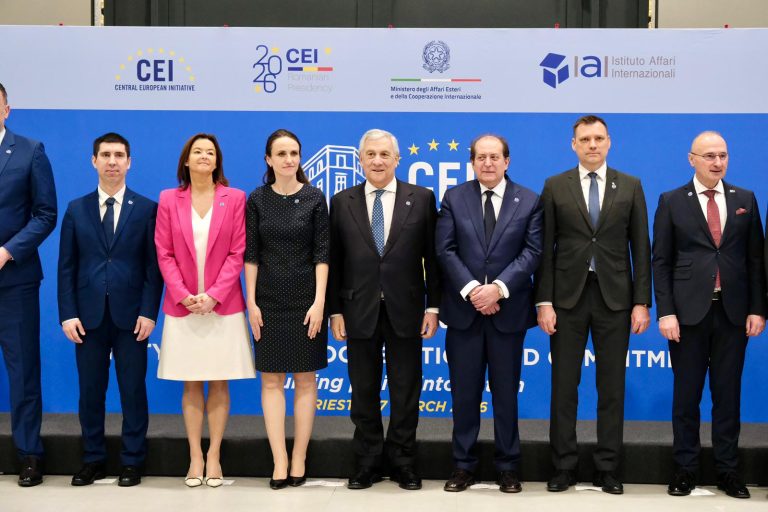
I welcome the Romanian Minister for Foreign Affairs, Oana Ţoiu, current Chair of the CEI.
I welcome the representatives of the Member States and international organisations present.
I welcome and thank the Secretary-General, my friend Franco Dal Mas, for the extraordinary work he is carrying out for the CEI.
I extend a warm greeting to President Craxi, to the members of our Parliaments, to the President of the Friuli Venezia Giulia Region, Fedriga, to the companies and to all the guests present.
I thank Ambassador Valensise and the Institute of International Affairs for their contribution to the organisation of this event.
I am particularly glad to welcome you to Trieste on the National Unity Day. A splendid city, once a symbol of division and today a crossroads of peace, dialogue and growth. A city at the heart of a region characterised by a dynamic and innovative economic fabric, well integrated into the economies of Central Europe and the Adriatic-Balkan region. A region that the Government wishes to place increasingly at the heart of its own commitment to growth and competitiveness. Because although the world is currently focused on the severe crisis in the Gulf and in Iran, we need not to lose sight of the future of our Europe, starting precisely with the path of enlargement or reunification, as I like to call it.
I am very pleased to announce that Italy intends to join the Three Seas Initiative as a Strategic Partner, which will make Trieste and the Friuli-Venezia Giulia Region an increasingly prominent player and a bridge for dialogue between the Adriatic, the Black Sea and the Baltic Sea.
Today marks an important anniversary – the first thirty years of the CEI Secretariat. A journey that demonstrates the value of an organisation which, over time, has become a point of reference in Europe.
By the end of the 1980s, a long era of ideological confrontation was finally drawing to a close, and a new phase was beginning, full of challenges and opportunities. Against that backdrop, Italy made a clear political choice – to overcome divisions and create an area for cooperation between the countries of Central and Eastern Europe and the Western Balkans. Those regions were – and are even more so today – a strategic priority for Italy and for Europe. It was an investment in dialogue, cooperation and the building of bridges between countries emerging from different histories and systems. That choice proved to be the right one. Today, around half of the Central European Initiative’s member countries are part of the European Union. This is the best proof of the CEI’s great political success.
Today we look forward to the next thirty years with ambition.
Anniversaries are not milestones, but a new beginning.
In an international scenario marked by instability and conflicts, we want an increasingly strong CEI, capable of promoting dialogue and growth for our citizens and companies. A major political platform for regional cooperation, contributing to the creation of a Europe that drives growth and competitiveness. A forum for dialogue that increasingly brings together regions, civil societies and Parliaments to promote shared values and principles.
In this endeavour, it is crucial to start with the process of reintegrating the Balkans into European history, an absolute strategic priority for the Government.
It is the greatest strategic investment in Europe.
2026 is a crucial year. We need to step up the integration process, and the CEI is called upon to provide a fundamental contribution.
The CEI is the only forum that brings together all the main candidate countries for EU membership, namely the Western Balkans, Ukraine and Moldova.
This is another reason why I wanted Secretary-General Dal Mas to attend the meetings of the Friends of the Western Balkans Group last year.
The video message that Minister Sybiha has sent us today bears witness to the importance of the CEI for Ukraine’s future as well. The CEI has already demonstrated its commitment to standing by Ukraine in concrete terms. It did so by suspending Belarus in 2022 and by participating in the Ukraine Recovery Conference held in Rome last July. Secretary-General Dal Mas was in Kyiv in November to convey a message of support and solidarity. The aim, however, is to do increasingly more. The CEI can make its expertise and regional network available for the reconstruction and future of Ukraine, promoting joint projects and the exchange of experiences. It is a challenge that will require commitment and determination, and one in which Italy will stand firmly alongside the CEI. I would like to share with you the dream that in 2027 Ukraine might take up the CEI’s Presidency!
The CEI will increasingly be called upon to play a leading role in the development of regional connectivity. Investing in connectivity means strengthening ties between countries and creating new growth opportunities for regions and companies. Italy has made the CEI-EBRD Fund available. We support infrastructure projects capable of connecting candidate countries to the European single market. I am thinking of Corridor VIII, the Trieste-Belgrade railway line and the power cable connecting Italy to Montenegro, which we aim to double. Just today I will be chairing a Conference on the IMEC economic and logistics corridor. This is a strategic project, on which we are working with India and other partners, to connect Europe and the Balkans with Asia’s large and dynamic markets. In this growth project, the Adriatic and Balkan region, with its ports and companies, will play a leading role.
In the period from the fall of the Berlin Wall to the present day, the CEI has established itself as a platform for dialogue, cooperation and growth for our companies.
Today, the CEI faces many new challenges. It is a path fraught with challenges, starting with enlargement, the commitment to new connectivity that keeps pace with the demands of these complex times, and support for Ukraine’s reconstruction.
It is a journey we want to undertake together. Italy will continue to play its part, with conviction and team spirit, to build a stronger, more united and more competitive Europe.
Best wishes to the CEI and all the best with your work!