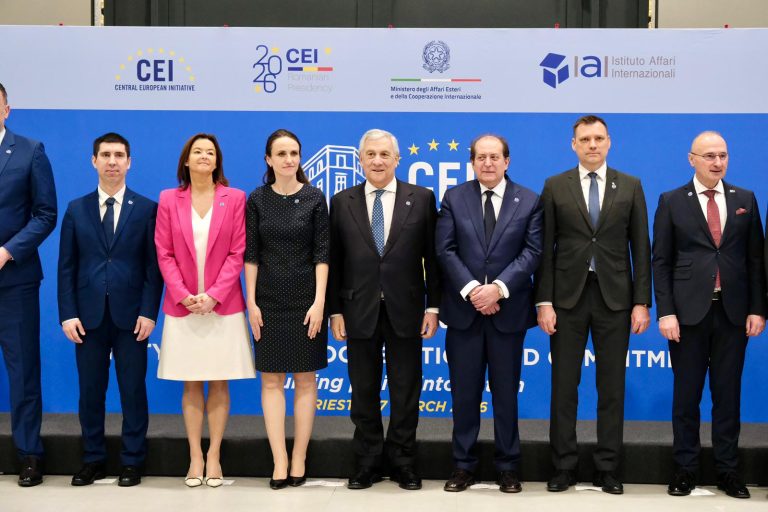
The Thirtieth anniversary of the establishment of the Executive Secretariat of the Central European Initiative represents a moment of profound symbolic and political significance in the journey of cooperation that unites our Member States. This milestone, marking the opening of the Trieste-based entity in 1996, offers a meaningful opportunity to highlight three decades of shared commitment to stability, growth, regional cooperation and European integration. It allows us to reaffirm the role of the CEI not merely as a forum for dialogue, but as a strategic bridging platform and a driver of economic and social development within the broader framework of Europe’s unity.
Central to this mission is the CEI’s role as a forum of discussion of political issues that are of common interest among all countries in the region, ranging across various sensitivities and perspectives of its Member States from Central Europe, Western Balkans and South-East Europe; as well as an enabler of European integration, also by supporting the enlargement process; and as an active player of diverse regional partnerships in Central and South-Eastern Europe. Today, the organization is well suited to provide fertile ground to link specialized regional formats, such as the Regional Cooperation Council (RCC), the South East European Cooperation Process (SEECP) or the Three Seas Initiative (3SI), as well as to embrace new paradigms stemming from the current European geopolitical and economic frameworks. The positive experience and concrete benefits of the CEI Member States that already joined the EU recalls us that the CEI is a cooperation format that fosters better preparedness of countries in the region looking at the EU accession.
By holding past and future together, the CEI serves a higher purpose and acts as a catalyst for reform and investment for its Member States. This is showcased by our commitment to the rule of law as the foundation of a predictable and stable environment for economic activity. The promising kick-off of the Falcone-Borsellino Programme in the field of legal diplomacy stands as a testament to what Member States can achieve through deep cooperation. It serves as a blueprint for our future efforts in supporting institutional reforms, strengthening judicial capacity-building, and ensuring integrity in public and private affairs; efforts that are crucial not only to attract investment but to ensure a level playing field across the region. By linking local sensitivities with international best-practices, the CEI has developed a unique method which could be enriched by new partnerships and memberships.
Driven by the same imperative for unity that propels the European integration process, the CEI should elevate its strategic ambitions over the coming decade. This vision finds its most practical expression in the field of connectivity, which is a concrete conduit for translating shared ambition into tangible reality. Sharing values and connecting countries, markets and people remain the cornerstone of advancing European integration, and the CEI is steadfast in promoting a model of connectivity that is not only effective but also locally sustainable.
In this context, the organization may play a pivotal role through the CEI Fund at the European Bank for Reconstruction and Development. This dedicated financial instrument, supported by the Italian government, has enabled technical assistance, capacity-building and know-how exchange that allow us to transform political will into concrete progress. Looking ahead, we aim to focus our efforts on projects directly linked to the European Union’s TEN-T corridors, along both the West-East and North-South axes. By bridging these corridors, we also facilitate the productive integration of Small and Medium Enterprises into regional and European markets, thereby contributing to the geopolitical stability and prosperity of the entire area.
To ensure that the CEI continues to meet these challenges with effectiveness and vision, we recognize the importance of strategizing for the long term. Taking into account recommendations on the CEI future set forth recently, the Organization will move toward a more politically committed and cooperation-oriented relationship with the European Union.
A key step in this process will be the expected contribution from the CEI Member States, through their National Coordinators and experts and in accordance with the CEI Guidelines and Rules of Procedure, in order to identifying the most promising fields of action for the Organization in the next decade, including inputs for the next Action Plan. The discussion and exchange of views over the celebratory conference of the CEI-ES anniversary and the follow up with the support of the Istituto Affari Internazionali (IAI) can provide a starting point for the reflections on the way ahead. This strategic planning will ensure that we continue to coordinate political leadership and effective administrative management. By involving national Parliaments and civil society organizations as pivotal stakeholders in our future, the CEI will continue to serve towards the EU enlargement goals, removing the remaining obstacles to full integration and acting as a permanent driver of reconciliation, regional cooperation, sustainable development and progress in Central, Eastern, and South-Eastern Europe.