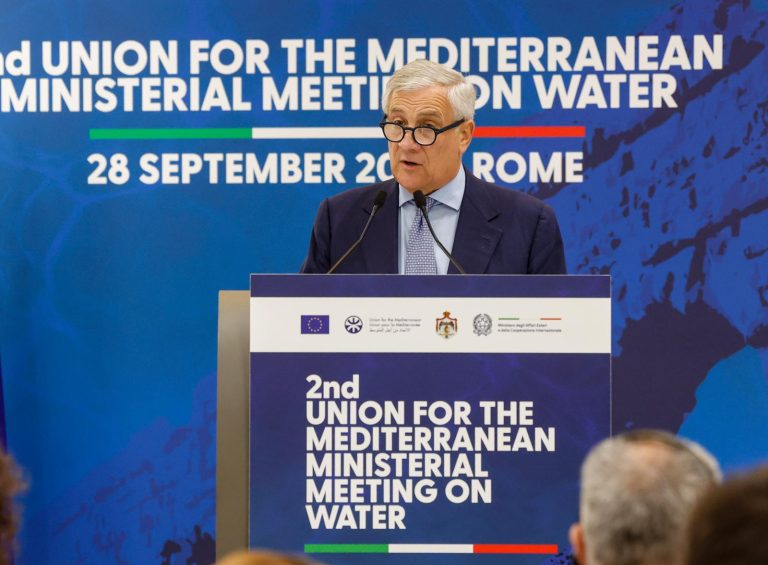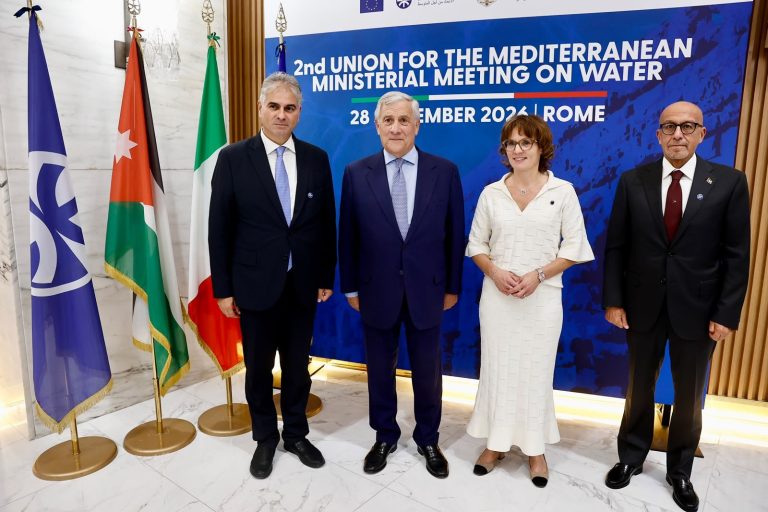
The Ministers of the Union for the Mediterranean members in charge of Water and other Heads of Delegation, meeting in Rome on the 28th of September 2026 under the Union for the Mediterranean Co-Presidency of H.E. Ms. Jessika Roswall, European Commissioner for Environment, Water Resilience and a Competitive Circular Economy, for the European Union, and H.E Mr. Eng. Raed Abu Soud, Minister of Water and Irrigation for the Hashemite Kingdom of Jordan, and in the presence of H.E. Mr. Fadi Hajali, Secretary General Ad Interim of the Union for the Mediterranean Secretariat, and the Republic of Italy as host country, reaffirm our call for an enhanced regional cooperation towards sustainable and integrated water management in the Mediterranean region.
- We, the Ministers in charge of water of the UfM member states and the UfM Co-Presidents, have gathered in Rome (Italy) to assess progress in achieving the objectives of the UfM Water Agenda, develop a new ambition and set new priorities and enhance cooperation on water, engage with relevant stakeholders, and provide the political impetus necessary to accelerate the achievement of the water-related Sustainable Development Goals (SDGs) in the Euro-Mediterranean region.
- This Declaration builds on the First UfM Ministerial Declaration on Water, agreed in Malta in 2017, that mandated the development of the UfM Water Agenda. We would like to express our gratitude to the UfM member states and stakeholders convened around the UfM Regional Platform on Water that have contributed to the development of the UfM Water Agenda. We would also like to express our appreciation for all the relevant work carried out at the international, regional, sub-regional and national levels, as appropriate, that has contributed to achieve the objectives of the UfM Water Agenda.
Contributing to the Global Water Agenda
- We appreciate that the global policy framework for water has evolved greatly since we met in Malta in 2017. The Sustainable Development Goals (SDGs) framework is now well established and has consolidated the importance of achieving specific water goals, as well as the importance of improving water policies to achieve many other SDGs. As we approach the SDGs deadline, without being on track to achieve the water-related goals and targets, we commit to engage in the preparation of the post 2030 framework, to ensure that water issues are appropriately recognised and prioritised and that the human rights to safe drinking water and sanitation are upheld.
- We note the progress made in strengthening global water governance, particularly as a follow up to the UN 2023 Water Conference. We acknowledge the coordination efforts to reach SDG-6 and in that regard, we note the adoption of a new UN system-wide strategy on water and sanitation as well as the appointment of the UN Special Envoy for Water. We commit to implement the UN Water Action Agenda based on the circumstances of each UfM member state, and to contribute to the success of the UN 2026 Water Conference that will take place in the United Arab Emirates in December 2026 by engaging with the preparatory process and collaborating with the UN Special Envoy for Water, the co-hosts and UN-Water to further showcase and raise the efforts in the EuroMediterranean region. We will submit this Ministerial Declaration as a contribution to the Conference.
- We welcome the presence of an increasingly strong Mediterranean voice in the successive editions of the World Water Forum. This has been facilitated by the organisation of the Mediterranean Water Forum in Cairo (2018), Malta (2021) and Tunis (2024). We look forward to the successful organisation of the Euro-Mediterranean Water Forum in Rome later this year and to the 11th World Water Forum in Riyadh in 2027, and we encourage the participants to be guided by this Ministerial Declaration.
- We recognise the increasing importance of mainstreaming water in other relevant global processes, in particular those related to climate change, biodiversity and desertification (the Rio Conventions). We thank Egypt for bringing water to the core of COP 27 of the UNFCCC in 2022 and note its Action on Water Adaptation and Resilience (AWARe) initiative. We express our appreciation to France and Kazakhstan for co-organising a breakthrough event on water, on the margins of COP 16 of the UNCCD in 2024, and we note the COP29 Declaration on Water for Climate Action. We highlight also the links between water management and a healthy Mediterranean, recalling the role of the Barcelona Convention, in particular the outcomes of the recent COP24 meeting in Cairo. We look forward to working with our government colleagues and stakeholders to further mainstream water in the different multilateral processes. We request the UfM to continue strengthening the mainstreaming of water issues in its work on sustainable and inclusive development across all sectors.
Addressing the critical water challenges in the Euro-Mediterranean region
- We reaffirm that water is a vital issue of common interest across the Euro-Mediterranean region and that we face a water crisis. The situation has significantly evolved since the First UfM Ministerial Declaration on Water. Climate change, economic development and population growth, including from migration, are key drivers putting additional pressures on water resources and services. Action to address the critical water challenges is more important and urgent than ever to ensure water resilience across the Euro-Mediterranean region.
- Water scarcity increasingly limits the socio-economic development of our peoples. We call for further sustainable actions in managing water demand, promoting water use efficiency, and developing conventional and non-conventional water resources — including desalination and water reuse
- Water pollution has major impacts on human health and ecosystems and further reduces the availability of adequate freshwater resources. We call for further action in water pollution prevention and control, including that related to industrial effluents, wastewater treatment compliance, micro-plastics, persistent and emerging pollutants, and diffuse pollution.
- Water-related disasters (including those caused by droughts, floods, wildfires and landslides) are increasing in frequency and intensity, leading to widespread human suffering and economic disruption. We call for a shift from reactive to anticipatory approaches in managing water-related risks (taking into account global and regional frameworks such as the Sendai Framework and the EU Preparedness Union Strategy), the integration of risk-informed planning and robust early warning systems in national water strategies, and the reinforcement of civil protection and community preparedness capacities.
- Lack of access to safe drinking water, sanitation and hygiene (WASH) services causes major health, education, social and economic costs (particularly for women and girls and vulnerable and disadvantaged groups) and it represents a breach of the human rights to water and sanitation. We call for further action to ensure universal access to WASH and to upgrade the management of WASH service provision.
- We commit to increase our efforts to address the critical water challenges in our countries.
- We will step up actions to achieve efficient, inclusive and integrated water resources management at all levels, including transboundary level as appropriate, that contributes to increase climate resilience.
- We will strive to integrate gender and youth considerations into all water policies, actions and investments, taking also into account vulnerable groups.
- We will promote efficient and sustainable management and use of water resources by all users, making water part of sustainable production and consumption.
- We will strive to harness the full potential of technological advances, including Artificial Intelligence (AI).
- We will work with our colleagues responsible for other relevant sectors to accelerate integrated policy-making and implementation in agriculture, energy, industrial development, urban development, transport, and environment.
- We will cooperate with financial authorities, financial partners, water service providers and water users, both public and private, to ensure that our water management and investment plans are financially realistic and fully funded – including through the development of national water finance frameworks that identify sustainable financing models and effective financing mechanisms.
- We emphasize the importance of expanding bilateral, sub-regional and regional cooperation to achieve our water goals. We acknowledge that international water cooperation can enhance water governance and management at the level of each UfM member state. We note with appreciation sub-regional cooperation, such as the 5+5 Water Strategy for the Western Mediterranean. Given the importance of ensuring sustainable use of water at all levels, we welcome efforts to advance transboundary water cooperation that can be beneficial to all riparians, in accordance with applicable international law, including international instruments countries are Parties to. We reaffirm that water cooperation is a source of prosperity and resilience, as it provides a strong basis for increasing trust among UfM member states and for expanding cooperation in other policy areas. We highlight the importance of mobilising domestic and international, public and private, financial resources to support a more ambitious water cooperation agenda in the Euro-Mediterranean region.
- We highlight that regional water cooperation in the Mediterranean is more important than ever. We reaffirm the relevance of the UfM Water Agenda in supporting national action and international water cooperation in our region. The UfM Water Agenda, which comprises the Policy Framework for Actions to 2030 and the Financial Strategy for Water, represents a Mediterranean approach to achieving the water-related sustainable development goals. We, UfM member states, undertake the implementation of the UfM Water Agenda, and have been making progress, through significant public investments, policy reforms, and institutional development, according to different national circumstances. We have benefited from the support of technical and financial partners, the critical and constructive contributions of civil society organisations, and the engagement of the private sector. We are encouraged by this support, contributions and engagement and look forward to their continuation and expansion.
- We welcome the European Union’s renewed focus on water and on cooperation with Mediterranean countries. We note the objectives of the European Water Resilience Strategy to make EU countries water-resilient, ensuring that water sources are properly managed and scarcity
- We underline the importance of regional solidarity in order to achieve the water-related SDGs at regional level. We are concerned with the negative impacts of conflicts in our region on water resources and the human right to safe drinking water and sanitation. For communities affected by armed conflicts, we encourage a holistic approach and therefore support protective measures (including safeguarding water resources and water infrastructure), humanitarian and emergency responses, recovery and reconstruction efforts, and development actions, while developing adequate integrated and phased financing strategies, and dedicated financing mechanisms.
- We recognise the important role of the UfM in bringing us together. The UfM has been a strong advocate of the region while progressively building its capacities to support the efforts of its member states through the Regional Platform on Water and its Working Groups. The regional sharing of individual experiences has benefited all UfM member states and supported the development of guidance and recommendations than can now be applied in each UfM member state in line with national circumstances. We request the UfM to continue this strategic work.
Our renewed ambition for the Euro-Mediterranean region
-
-
-
- By 2030, we aim to:
- Achieve SDG-6 and the other water-related SDGs in every UfM member state.
- Significantly increase water resilience in every UfM member state, embedding disaster risk reduction and climate change adaptation and mitigation at the core of sustainable water management and investment planning.
- Make water everybody’s business — by promoting a whole-of society and a whole-ofgovernment approach that ensures the contribution of all relevant sectors and enhances the contribution of all relevant actor and partners (including local authorities, the private sector, and civil society, with special attention to the effective participation of women, youth and vulnerable people), as appropriate.
- Demonstrate that regional and other forms of water cooperation support the economic, social and environmental progress of our countries.
-
-
Priorities for regional cooperation
-
-
-
- Water governance. We recognise that effective and inclusive water governance is key for achieving the water-related SDGs. We will continue to lead the implementation of Integrated Water Resources Management (IWRM) at all levels. We encourage UfM member states to cooperate on transboundary waters. We invite those UfM Member States that are Parties to, or interested in exploring, the Convention on the Protection and Use of Transboundary Watercourses and International Lakes (Water Convention) to use its framework and tools for such cooperation. We also recognize that water governance is key to the prevention and management of water-related disasters as it ensures coordination, planning, and increased resilience. We mandate the UfM Regional Platform on Water and its individual members to further support the exchange of knowledge and experiences for developing effective water institutional frameworks and achieving effective water governance.
- The Water-Energy-Food-Ecosystem (WEFE) Nexus. We recognise, as highlighted in our previous declaration, that water, energy, food and agriculture, and ecosystems issues are inextricably linked in the Mediterranean region, and further recognise that the effective mainstreaming and management of the WEFE nexus is key including the involvement of all relevant sectors for securing major economic, social and environmental benefits. We will continue to deepen the application of integrated water resources management (IWRM) at all levels, by focusing renewed efforts on ensuring that the WEFE Nexus is properly addressed, guided by the new Strategy for the WaterEnergy-Food-Ecosystems Nexus in the Mediterranean Source to Sea Continuum. We mandate the UfM Regional Platform on Water to work with individual UfM member states and relevant partners in the elaboration of a regional framework of actions that would facilitate stronger engagement of other sectors in the management of the WEFE nexus, and to promote the development and financing of WEFE nexus investment projects and programmes (including those for technology transfer and capacity development).
- Water finance and investment. We recognise that achieving SDG-6 and the other water-related SDGs requires major investments in water resources management and water services. Finance is required for investing in resilient water infrastructure (including non-conventional water resources) but also for operating and maintaining it, as well as for improving water governance and management. We will strive to make the best use of financial resources, including through improved accountability on how they are mobilised, allocated and used. We will continue to work towards enhancing the financial sustainability of the water sector, guided by the 2018 UfM Financial Strategy for Water and applying the new UfM Recommendations on Water Finance. We mandate the UfM Regional Platform on Water to continue developing policy advice in the area of water finance and investment and to facilitate its uptake by individual UfM member states that request this support, also in synergy with relevant international initiatives.
- Digitalization of the water sector. We recognise that the digitalization of the water sector offers a major opportunity for increasing the effectiveness and efficiency of the water sector, both regarding water resources and water services, and can deliver major economic benefits. We will strive to lead the progress towards the digitalization of their water sector, guided by the new UfM Regional Strategic Framework for the Digitalization of the Water Sector. We mandate the UfM Regional Platform on Water and its individual members to support the implementation of national strategies for the digitalization of the water sector.
- Water and climate resilience. We recognise that climate change needs to be mainstreamed across the whole water sector, and that climate-resilient water management must consider compound and cascading risks, including those arising from interdependencies with food, health, energy, and disaster systems. We will lead in building a climate- and disaster-resilient water sector reducing its carbon footprint and increasing its capacity to prevent, absorb, and recover from shocks, including those caused by extreme climate events. At the same time, water needs to be mainstreamed in climate policies, including in nationally determined contributions and national adaptation plans where appropriate. We mandate the UfM Regional Platform on Water to continue supporting UfM member states in integrating climate issues in the water sector through a transversal approach in its WEFE Nexus, Water Finance and Water Digitalisation work, including by supporting individual member states to apply the recommendations of the 2022 UfM Cairo Action Agenda on Water, Climate and Finance.
-
-
A stronger multi-stakeholder platform to support progress
-
-
-
- We commit to strengthen the UfM Regional Platform on Water (RPWater) so that it can effectively support our commonly agreed water goals by providing recommendations and enhancing cooperation efforts.
- We commit that representation on the RPWater from UfM member states will be at Water Director level (or an alternate appointed by the Water Director) and that efforts are made so that at least once every two years, the meeting of RPWater takes place back-to-back with the meetings of the EU Water Directors.
- We request RPWater to develop a multi-year work programme, based on our agreed regional priorities and implemented through Working Groups as necessary, taking into account the capacity of the UfM Secretariat.
- We request RPWater to facilitate documenting of national progress and regional cooperation efforts by UfM member states and their Partners on a voluntary basis.
- We request technical and financial partners, as well as the private sector and other stakeholders, to increase their level of engagement in RPWater, and we mandate RPWater to facilitate this greater engagement.
-
-
The Rome Initiative on Water
-
-
-
- We note the Rome Initiative on Water to support our renewed ambition, as a practical proof of our collective commitment to work together to advance towards our common water goals. The objectives of the Rome Initiative are (a) to contribute to develop the technical capacities needed to address the priorities identified in this Declaration, including for the development of comprehensive water management and investment planning, and (b) to facilitate the design, financing and management of sustainable projects. The Rome Initiative will build upon and leverage the framework established by the new Pact for the Mediterranean, with the aim to strengthen regional cooperation and deliver concrete improvements in water management across the Mediterranean basin. We mandate the UfM Secretariat to continue to take the lead in further developing this new regional initiative, and we request the Regional Platform on Water to oversee its development and implementation. The Rome Initiative represents a Mediterranean contribution to the upcoming UN 2026 Water Conference.
- Finally, we express our deep gratitude to the Government of Italy for its warm hospitality and to the UfM Secretariat for helping to convene this meeting.
-
-