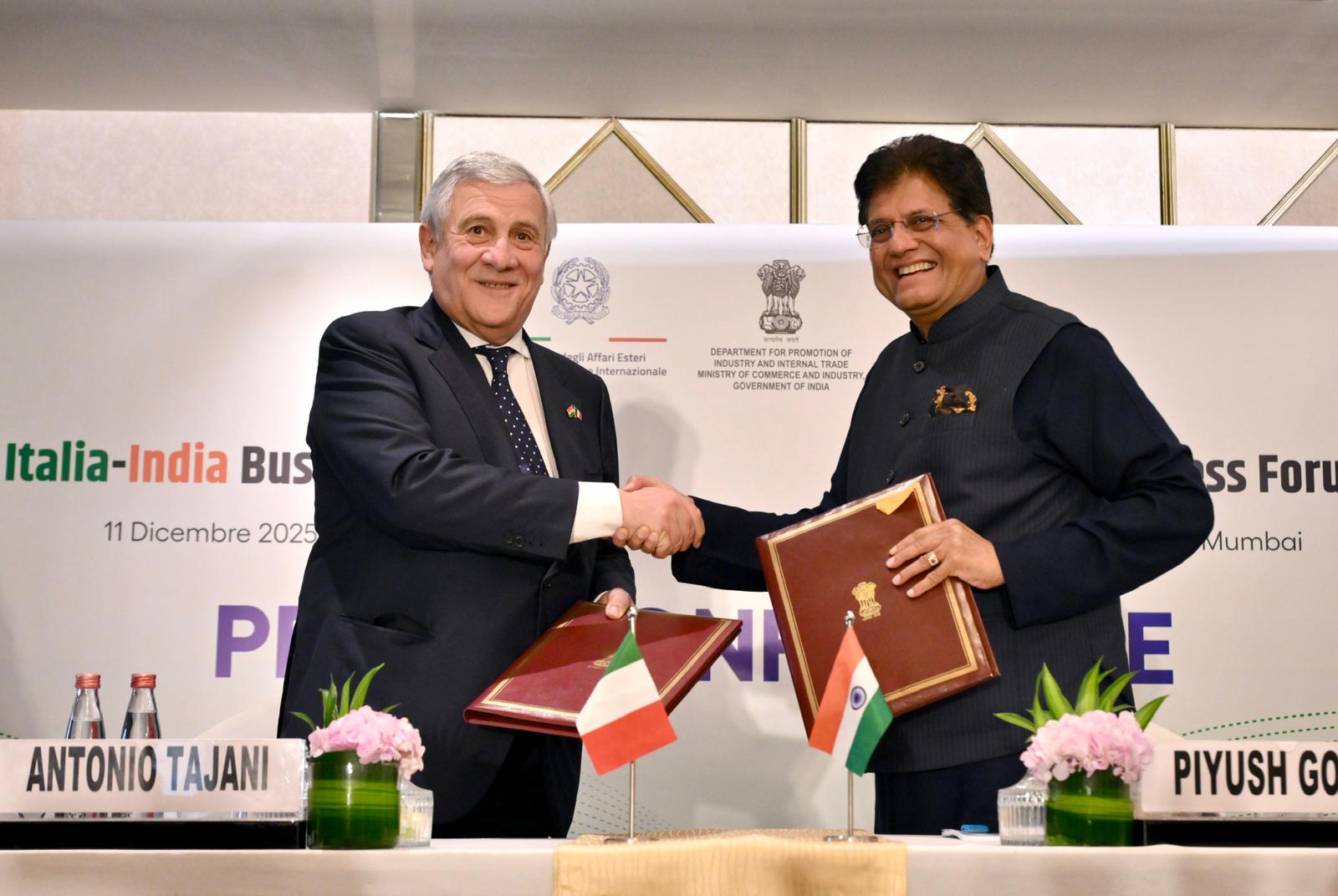
During the third National Conference on Exports and Business Internationalization, a video message from the Indian Minister of Commerce and Industry, Piyush Vedprakash Goyal, was broadcast. While emphasizing that the partnership between Italy and India is more positive and promising than ever, the Minister added that the two countries were not in competition: “We complement each other. Our relationship is rooted in centuries of history and has evolved into a strategic partnership, with our bilateral trade currently worth $14 billion.” According to the Indian Minister, this level of partnership can be further improved, “given the scope and magnitude of the opportunities opened up by this partnership, within the framework of the Italy-India Strategic Action Plan 2025-2029, which sees the two countries committed to cooperation in the sectors of clean energy, defence, artificial intelligence, and sustainable mobility.”
The video message also made reference to the Business Forum held in New Delhi and Mumbai on December 10 and 11, 2025. In Mumbai, together with his “friend and Industry Minister Piyush Goyal,” Minister Tajani had opened the third Italy-India Business Forum by saying: “There are already 700 Italian companies operating in India. We want to attract more investment, create synergies between companies, and facilitate trade, by also creating an innovation hub in India, to further strengthen our ecosystems. Our shared goal is to reach €20 billion in trade by 2029”.
Asia for Diversifying
“Micro, small, and medium-sized enterprises account for over 50% of Italian manufacturing exports – a factor that fosters the flexibility and resilience of the business community.” Dario Scannapieco, CEO of Cassa Depositi e Prestiti (CDP) stated as much at the panel entitled “The Role of Large Enterprises in Supporting SME Supply Chains” during the National Conference on Exports and Business Internationalization last December. He added: “Today, our target markets are primarily Europe and the United States, but we need to increasingly diversify toward other economies. For example, Asian economies like India, where we can play a leading role. CDP is focusing its attention on this system of companies, as demonstrated by the roadshow across Italy that we promoted together with Confindustria to illustrate what Cassa Depositi e Prestiti can do for SMEs wishing to expand abroad.”
The Business Forum in India, two days of networking
Rebalancing trade, mutual investment, research, and innovation. These were the central topics addressed by the Deputy Prime Minister and Foreign Minister, Antonio Tajani, during his visit to India: first at a working breakfast in Delhi on December 10 with Prime Minister Narendra Modi’s economic advisors, and then on December 11 in Mumbai during a bilateral meeting with the Minister of Industry and Commerce, Piyush Goyal.
Both sides underlined that the two countries are complementary: on the one hand, advanced technology and manufacturing, on the other, skilled labour. This complementarity is reflected in three major areas: traditional Italian sectors – design, fashion, precision agriculture, packaging, and pharmaceuticals; the so-called high-potential “sunk sectors” – in industry, such as space and sports, and in services, such as tourism, culture, and creative industries; and finally, high-tech sectors, including data centres and artificial intelligence.
The need for the financial system to support the development of the economic partnership was a concept reiterated by Prime Minister Modi, a concept fully endorsed by Minister Tajani. The topics addressed in the meeting included the listing of Indian companies on the Milan Stock Exchange and Italian companies on the Mumbai Stock Exchange; the attractiveness of Italian stocks – among the safest in Europe – and the solidity of Italian private savings, which should be channelled toward high-yield sectors.
The third major topic was innovation and artificial intelligence. India has a great opportunity to build both physical and digital infrastructure simultaneously. Every Indian citizen has a digital identity, which has enabled the proliferation of bank accounts, now almost exclusively tied to phones: India has one billion WhatsApp users.
At the Italy-India Business Forum in Mumbai, the third in eight months, 50 Italian and 150 Indian companies participated in B2B meetings and various networking opportunities. The Forum focused on sectors with high potential for collaboration, in line with the Joint Strategic Action Plan adopted in November 2024 by Prime Ministers Giorgia Meloni and Narendra Modi: automotive components, sports technologies, agri-food sector, and waste-to-energy/renewables.
December 10
On December 10, four industry-specific roundtables were organized to enable Italian companies to interact with representatives of Indian associations, learn about the main opportunities in the local market, and visit leading Indian companies.
In the sports sector, following a presentation by Grant Thornton Bharat’s Sport Advisory, Italian companies visited the Indian Institute of Sports Management and met with leading Indian companies specializing in sporting goods, equipment, gyms, and sportswear.
In the automotive components sector, the Automotive Component Manufacturers Association (ACMA) presented the opportunities in the industry, followed by a presentation by Greaves Cotton – a company producing clean-technology powertrains – and a visit to Ashok Leyland, India’s second-largest commercial vehicle manufacturer. Italian companies could interact with various divisions of the Hinduja Group, a major Indian conglomerate operating in eleven sectors, including the automotive sector.
The CII ITC Center of Excellence on Sustainable Development illustrated opportunities in the energy and renewables sector. The Italian companies later visited ION Exchange, a leading company in water and environmental resource management, for a discussion focused on promoting sustainable technologies to support India’s transition to a zero-emissions future.
In the agri-food sector, after a presentation of the industry, the delegation visited Godrej Agrivet, a leading integrated agribusiness operator, and ADF Foods, a processor of packaged food products.
At the end of the visits, Deependra Kushwah, Development Commissioner for Industries of Maharashtra, highlighted the region’s opportunities for foreign companies, followed by a presentation of the SBIA (Shendra Bidkin Industrial Area) industrial park, a large-scale cluster with extensive infrastructure services.
December 11
On December 11, the Business Forum opened with sessions for presenting the four sectors, followed by a plenary conference. Italian companies, selected thanks to the contribution of the Italian System and the Chamber of Commerce, were involved in four thematic roundtables.
The agri-food roundtable featured Preet Pal Singh, Joint Secretary of the Ministry of Food Processing Industries, as well as a select group of Indian companies and operators. The roundtable attracted many leading Italian companies operating along the entire agri-food value chain, thus confirming the sector’s strategic importance for the Italian System.
The presentation by Enrico Carraro, President of the Carraro Group, who arrived in India over thirty years ago, was particularly noteworthy. Carraro emphasized that most of the investment of the Group – with a total turnover of approximately €800 million – is currently concentrated in India, where it employs approximately 2,000 people. He noted that approximately 25% of capital is held by Indian investors, following its listing on the Mumbai Stock Exchange in December 2024. Significant contributions also came from Clevertech, a group specializing in advanced automation and packaging solutions, and Maschio Gaspardo, a manufacturer of agricultural machinery and equipment.
Three key messages emerged: a strong shared interest in expanding cooperation in food processing technologies and value creation along the supply chain; the importance of industrial partnerships with a strong local presence based on joint ventures, technology transfer, and skills development; and the cross-cutting priority given to sustainability, quality standards, and efficiency.
At the waste-to-energy/renewables roundtable, the discussion focused on collaboration in waste management, energy production and transformation, as well as the impact of recycling methods. The contributions of the Italian companies present—including Gruppo Cavagna, Coesa, RMB, Teknofanghi, Walter Tosto, Maire, and RINA Consulting—highlighted not only their technical expertise, but also their ability to cover various segments of the energy sector. Italy’s international leadership in waste recycling, technology used, and energy recovery was confirmed, while maintaining high quality standards and a strong focus on sustainability. The discussion highlighted the opportunities that the Indian market can open up, both in terms of numbers and local interest in management, innovation, and energy transition.
At the sports roundtable, opportunities for collaboration between Italy and India were discussed, particularly in view of the 2030 Commonwealth Games. On the Italian side, companies specialized in various fields – ranging from competitions to construction, and equipment – were present. Government representatives from the States of Maharashtra and Gujarat participated, reaffirming their support for India’s ambitions and providing suggestions for future joint ventures in the sports sector. The discussion highlighted a concrete interest in integrated solutions combining quality infrastructure, performance technologies, and the digitalisation of sporting events.
Several medium-sized Italian companies attended the automotive components roundtable. Many of them, already present on international markets, expressed their intention to shift production from China to India, considering the significant opportunities provided by the sector. Representatives from the State of Gujarat expressed their full availability and support, including financial support, to Italian companies intending to establish themselves in India.
Messages from the Plenary and Bilateral Meetings
In his plenary address, Minister Tajani emphasized the particularly positive phase of the partnership between Italy and India, both at the institutional and business levels. The Deputy Prime Minister outlined some of the priorities: the India-Middle East-Europe Economic Corridor (IMEC), with the Trieste Summit on March 17, 2026; bilateral collaboration in innovation, research, and education; and sectors where ties can be strengthened, ranging from sports to automotive, defence, space, culture, and tourism. Particular attention was paid to raw materials, the cost of which continues to rise.
The Indian Minister of Commerce and Industry, Piyush Goyal, emphasized that India has held three Business Forums with no other country in such a short time and that there is serious mutual interest in investment, trade, joint ventures, research and development, technology, innovation, textiles, sports, defence, space, and agri-food. As he said, sports in particular is an interesting sector, especially considering the Commonwealth Games to be held in Ahmedabad in 2030 and India’s ambition to host the Olympics in 2036.
During the bilateral meeting, the two Ministers reviewed the main dossiers: business forums, FTAs, IMECs, innovation, and investment. Minister Tajani emphasized that organizing three such high-level business forums in just a few months is not to be taken for granted, and he immediately invited Minister Goyal to a fourth one to be held in Italy. With specific reference to investment, he reaffirmed his determination to attract more foreign quality investment – and especially Indian investment – aimed at creating jobs and development. He also emphasized the importance of potential triangulations, particularly with Africa.
On the topic of connectivity between Italy and India, Minister Goyal expressed great appreciation for Italy’s commitment to shaping and developing IMEC. Regarding the Innovit project, he enthusiastically welcomed the initiative, recognizing its fundamental importance and great potential, to the point of proposing to explore other possible locations, along with Delhi and Bangalore: one on the west coast (Mumbai or GIFT City) and one in the east (Assam).
Meeting with Indian unicorns
The Ministers also met with a delegation of Indian unicorns—startups with a market valuation exceeding $1 billion – in the presence of representatives of the Italian System. Thanks to an average population age of around 28 and a large smartphone user base (over 900 million), factors that favour the adoption of innovative technological solutions, India is the third country in the world after the United States and China in terms of number of unicorns. According to the latest Global Startup Ecosystem Report, Bangalore, Delhi, and Mumbai rank 14th, 29th, and 40th globally, respectively, for startup ecosystem dynamism.
The meeting also proved to be an important opportunity for discussion regarding the launch of the Innovit initiative, which will focus on accelerator programs for startups and the development of connections between the Italian and Indian innovation ecosystems. The unicorns present included Pharmeasy/AllHome, OneCard, Paytm, Pristyn Care, Ease My Trip, StarAgri, boAt, Razorpay, Billdesk, Purplle, Infra.Market, Miko, BatX Energies, Agnikul, and Meesho.
Announcements and Agreements
Several agreements were signed and announced during the Business Forum: a Memorandum of Understanding between SIMEST and the Indian Chamber of Commerce (ICC) was signed to strengthen economic cooperation between the two countries and foster new bilateral investment opportunities. Cavagna Group and Ace Brass established Cavagna Group Ace Brass Tech Private Limited, with Cavagna holding a 51% stake and an Italian investment in the production of gas control, regulation, and measurement equipment and components. Steel Authority of India Limited (SAIL), India’s largest State-owned steel company, and Danieli, a manufacturer of steelmaking equipment and technologies, signed an agreement for three major projects worth a total of €500 million. In the fashion sector, Prada reached an agreement with local partners Lidcom and Lidkar to produce Kolhapuri sandals in the State of Maharashtra; and Carpisa signed an agreement with Neopolis Brands to open stores in India, with the aim of eventually opening up to one hundred stores.