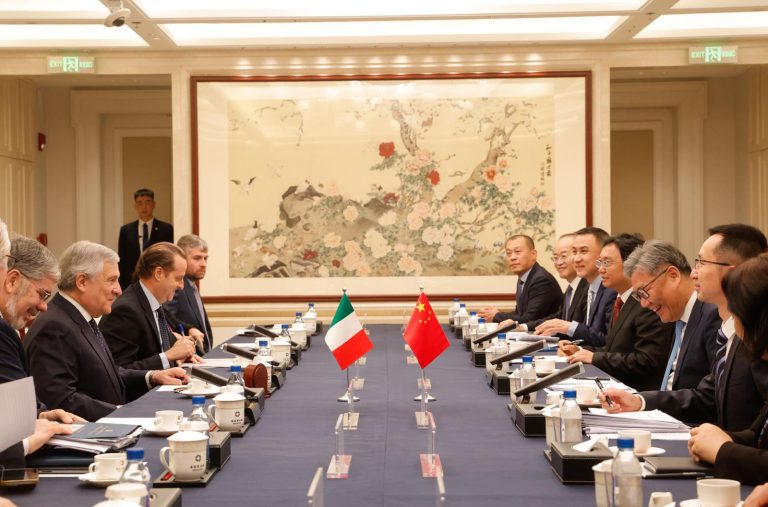
Minister Antonio Tajani, you are wrapping up a mission to China focused on trade and economic cooperation. You arrived in Beijing at a very sensitive time, particularly considering the war in Iran.
Tajani: “I have come to China because it is essential to be here: China is an economic giant with which Italy, as an exporting nation, wishes to maintain open and ever-stronger channels. It is an important market for our exports and for the internationalisation of companies, a fundamental part of the Foreign Ministry’s Export Plan. Having stepped back from the ‘Silk Road’ initiative does not mean we have given up on maintaining solid economic relations, which remain based on the ‘Strategic Partnership’ signed by Berlusconi in 2004. We hold differing positions on certain issues, but China is one of the world’s two great superpowers, a key player alongside the United States on the UN Security Council, and a major player on the international and multilateral political scene. My mission has been very positive, both from a political and economic perspective: we have noted promising opportunities for our companies.”
What did the Chinese Ministers tell you about the war in Iran and the blockade of the Strait of Hormuz, in particular?
“Foreign Minister Wang Yi shares our call to ensure the free passage of merchant ships through the Strait of Hormuz: no one can claim the right to block international trade, and no one can impose a toll. That war needs to be stopped through diplomacy, and the latest reports give us cause for hope.”
Two years have elapsed since the ‘Belt and Road Initiative’ agreement was signed; Italy was the only G7 country to sign it, but then you withdrew. What is the state of trade relations?
“We have long been calling for a rebalancing of trade between our two countries. I have detected a political willingness on the Chinese side to meet us halfway on many issues. For example, they have informed me that the authorities are about to crack down on other companies using fake Italian names – examples of ‘Italian-sounding’ brands that exploit a slight resemblance to the Italian language. The Chinese leadership is cooperating; they are helping us resolve many trademark issues.”
As the EU has pointed out, however, China remains the country with the most trade barriers.
“The Chinese market is highly regulated; we need to make access easier by supporting the internationalisation of Italian companies. In China, we have 1,500 companies generating a turnover of 33 billion euros. We are calling for greater openness regarding certain aspects of excessive regulation in their market. China is our fourth-largest trading partner globally and the largest in Asia, yet our trade deficit continues to rise, currently standing at 46 billion. This the reason why I have asked Trade Minister Wang Wentao to increase market access opportunities for Italian-made goods. An action plan has been signed; we have high expectations in sectors such as jewellery, agri-food, cosmetics and public procurement.
The Italian agri-food sector has indeed faced many obstacles over the years.
“We discussed this in a session dedicated to the topic: for us, it is crucial to restart exports of key products, particularly beef and pork. We also talked about the jewellery sector at length, in which there are licensing issues we wish to overcome. Every single action is vital to support commercial and industrial sectors that provide many jobs in Italy.”
Did you also discuss e-commerce, and why?
“The scale of trade on e-commerce platforms in China is significant: 27% of Chinese trade, amounting to $2.4 trillion a year, takes place on e-commerce platforms. To sell high-fashion garments, luxury shoes or even just Parmesan cheese in China, you have to be on e-commerce platforms. Through ITA, we help Italian groups to connect with logistics chains capable of meeting the demands of Chinese users on Alibaba or other platforms; SMEs cannot do everything on their own, and this is where our support, from the whole Italian System, makes the difference.”
A key issue is the ‘golden power’: how did you explain the recent decision regarding Pirelli?
“I told the Chinese Minister of Commerce, who raised the issue, that the “golden power” was adopted by the government to ensure Pirelli’s presence on the US market. The way it was adopted, however, will not cause financial harm to Chinese shareholders. The “golden power” is not intended to be an obstacle to foreign investors, let alone Chinese ones. In 2025, only 40 out of 1,000 transactions notified to the Government were subject to scrutiny, and veto was exercised only twice.”
There has also been time for seemingly minor agreements, such as another flight to Venice and the rights to broadcast A League football matches on Chinese state television…
“They may seem minor agreements, but they are further evidence of the interest between the two countries. Following the Venice-Shanghai flight, we will now have a Venice-Beijing flight: Chinese and Italian tourists in Beijing and Venice, but also a direct link for entrepreneurs from the productive North-East. The Italian A League football matches broadcast on Chinese TV is another area of friendship between the two nations, a draw for tourists. It is not just about politics or the economy; sport, too, can bring two peoples together.”
Culture can do it, too: in Beijing, where 33 billion people live, there are constant exhibitions on Italian art and history.
“At the moment there are 11 such exhibitions, including two currently running simultaneously at the National Museum of China, on Palladio and Pompeii. The presence of Italian culture in China is one of our country’s most important assets, and the cultural industry is a tool for fostering friendship. Yesterday in Beijing, I opened the Uffizi Museum exhibition dedicated to the Italian Renaissance Masters, an event set in a technologically futuristic immersive space featuring works of art on loan from the Uffizi Museum. A “Treccani Palace’ is to be established in Shanghai, a cultural hub that will strengthen Italy’s role in this sector. This mission to China is part of the Government’s work on exports: we have increased funding for ITA, and we have boosted SIMEST’s non-repayable grants for exporting companies facing the energy crisis. Exports account for almost 40% of GDP: supporting exports is a key priority for the Government in order to strengthen the entire Italian economy.”