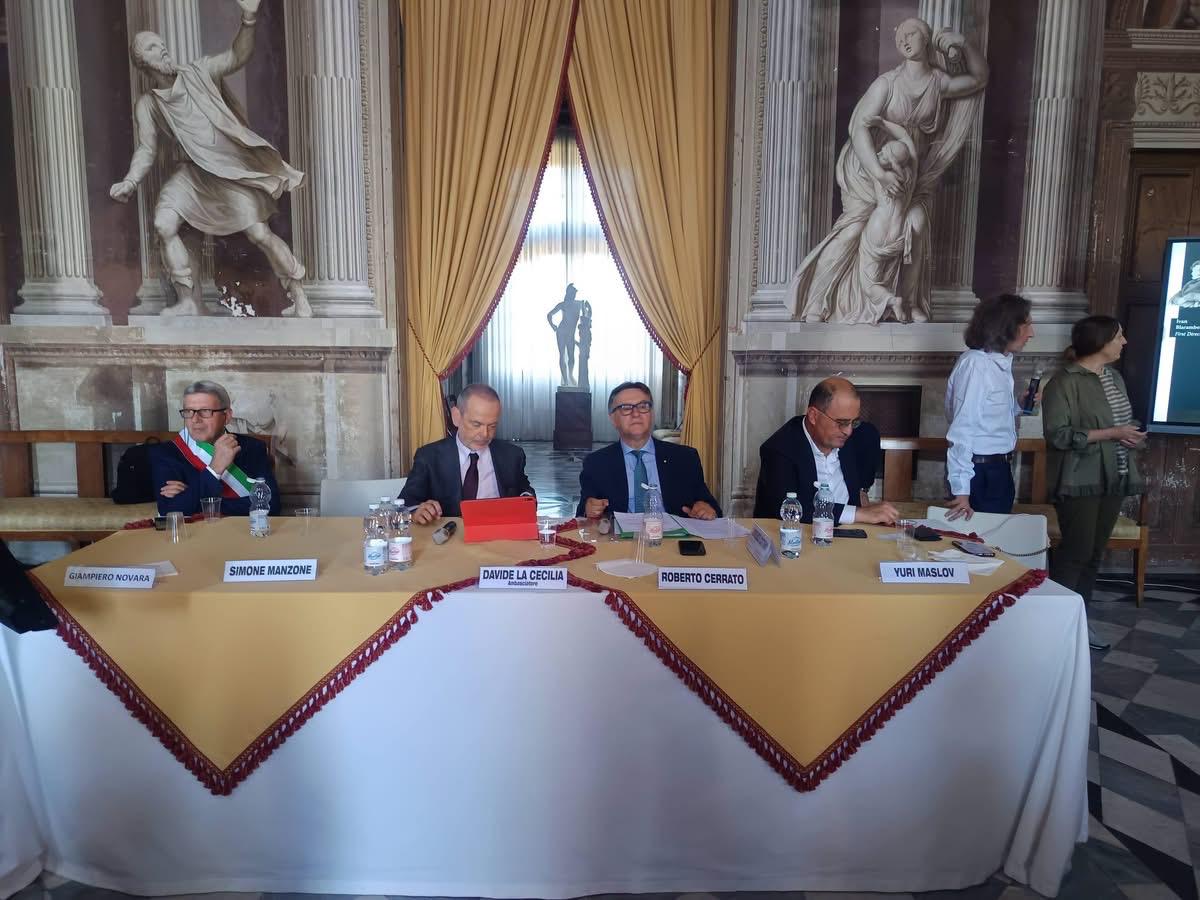
The Foreign Ministry’s Special Envoy for the reconstruction and resilience of Ukraine, Davide La Cecilia, participated in the “Energy for Reconstruction” Conference held in Govone on July 9. Organized by Roberto Cerrato, President of the Langhe Roero Monferrato Study Center, the Conference was attended by representatives of the Piedmont Region, the Province of Cuneo, the mayors of Govone, and local Municipalities.
Special Envoy La Cecilia conveyed greetings from Minister Tajani to the participants, recalling that “since the beginning of the conflict, he wanted to establish a Task Force for Ukraine at the Foreign Ministry, as well as an inter-Ministerial Table bringing together companies and trade associations interested in reconstruction.” The President of the Langhe Roero Monferrato Study Center expressed the hope that “a day like this will give rise to permanent projects to be implemented at Govone Castle, involving researchers, scholars, entrepreneurs, and professionals, related to the reconstruction of Ukraine.”
The event took place at the Savoy Residence of Govone Castle in the Province of Cuneo, which, along with other Savoy Residences in Piedmont, was inscribed on the UNESCO World Heritage List in 2014.
The initiative follows the signing of the Strategic Cooperation Agreement in early 2026 between the Odessa Archaeological Museum (of which Italy has taken up patronage for reconstruction), the Royal Castle of Govone, and local companies. The agreement links cultural heritage protection, urban regeneration, energy infrastructure, and project financing, with the aim of turning pilot sites into replicable models for the reconstruction of Ukraine. The technical and scientific direction is provided by the Energy Center of the Polytechnic University of Turin.
Since 2022, Italy has been committed to supporting Ukraine’s energy resilience through cooperation programmes, private donations channelled through the Civil Protection Agency, as well as equipment and materials. At the same time, long-term resilience is being promoted through the creation of a widespread energy network as part of the process of integration into the European Energy Union.