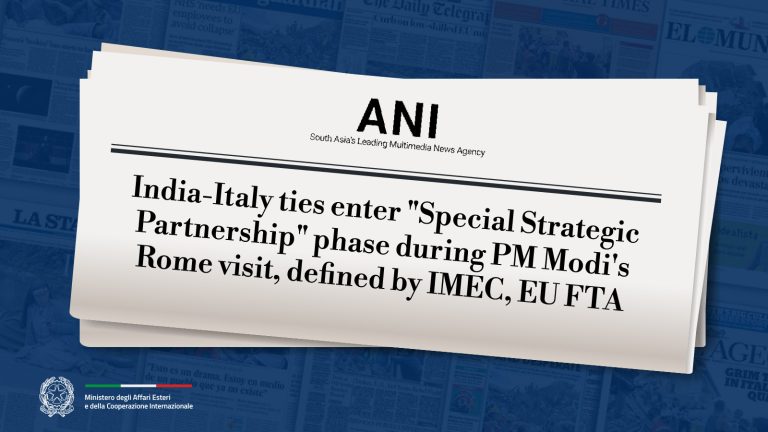
In 2026, Italy plans to invest an additional €500 million in India. Also, India and Italy have set a target of achieving bilateral trade worth $20 billion by 2029. Accordingly, the Italian Ministry of Foreign Affairs, through the agency SIMEST, has launched a dedicated financing line to India to support Italian companies entering the local market and creating joint ventures.
“India is a priority for Italy and a long-trusted friend,” said Antonio Tajani, deputy prime minister, Italy, during his recent visit to India. “Italian companies are getting increasingly interested in this extraordinary and opportunity-rich country. We not only want to export more, but we also want to increase industrial collaborations, joint ventures, co-development and co-production projects.”
The FTA between India and the EU is amongst the most awaited, and Tajani said he was optimistic of its early conclusion. “We sincerely believe that it would be concluded early,” Tajani told Business India. While in India, he attended the Italy-India Business Forum.
“With the India-EU FTA negotiations underway, our partnership with Italy will have a pivotal role to play in unlocking new opportunities and driving our shared development goals,” said Piyush Goyal, Union minister for commerce, after meeting Tajani. He also reiterated India’s commitment to deepen the economic and industrial partnership with Italy, with the aim to expand trade, boost investments and elevate business collaboration.
Tajani visited the National Stock Exchange in Mumbai to underscore the important role finance can play in the further advancement of Italy-India bilateral partnership, particularly in the economy, innovation and investment.
Tajani interacted with Italian and Indian representatives of funds and financial authorities. The exchange of views focused on future economic perspectives and possible synergies between the two countries.
Talking about the robust investment environment, Italian officials pointed out that 9,266 funds and 2,397 investment firms from 58 countries have invested in Italian listed companies.
India-Italy trade is growing, with bilateral trade touching $14.5 billion in 2023-24, making Italy India’s fourth-largest EU partner. Key exports from India include garments, leather and auto parts, while Italy sends machinery, chemicals and energy to India. Both countries are aiming for deeper tech/ industrial co-operation, eyeing a $20 billion trade goal by 2029 via joint ventures and strategic plans.
“About 700 Italian companies are already operating in India,” informed Tajani, while participating in the business forum. “We want to welcome more investments, create synergies between companies and facilitate exchanges also through the creation of an innovation hub in India, to make our ecosystems work even more. The common goal is to reach trade worth $20 billion by 2029.”
Goyal, however, declined to give a timeline by which he expects the deal to be signed, but assured that all the issues will be resolved to have a fair, balanced and equitable deal which will be a win-win for all. The minister felt that the deal between the economies of size, scale and growth potential as India and the European Union, will be a ‘defining agreement’ of the 21st century.
A sense of urgency
“Obviously, it will take time,” Goyal said, “as we have a lot of things to consider. You need to crystal gaze into the future, you need to ensure that sensitivities on both sides are protected, and you need to grab the low-hanging fruit, so that businesses and people on both sides will benefit.” Negotiations are on with a sense of urgency, but never in haste or with a deadline, he added.
The minister said countries like Italy will be able to export their wines and automobiles to India and, in turn, India will be able to export whiskies, textiles and auto components to the 27-country bloc. Both Goyal and Tajani stressed the need for cooperation between democracies for the smooth supply of raw materials in the global market. The Indian minister also flagged concentration risks amid the weaponisation of trade.
The Italian Deputy PM felt that one country cannot play a ‘kingmaker’ and decide the raw material prices, which are critical for production. There is a need for a ‘political agreement’ between Italy, the rest of Europe, India, Japan and the US on this aspect, he added.
Tajani marked pharma, maritime security, technology and defence as among the sectors where India and Italy can cooperate. He also stressed the important role the bilateral partnership will play in making the India-Middle East-Europe Economic Corridor a reality. “We (Italy and India) are paving the way for strong action in favour of trade and in favour of infrastructure. This corridor is also important for peace,” Tajani affirmed.
According to Goyal, given the deepening ties between Rome and New Delhi, India-Italy ties will be a defining relationship of the 21st century. Sports, in Goyal’s opinion, is another area where both countries should focus. He expressed hope that Italy would back India’s bid to host the 2036 Olympics.
Italy’s Deputy PM’s visit signals push to deepen India economic ties
New Delhi: Italy’s Deputy Prime Minister Antonio Tajani’s recent visit to India, marked by his engagement with the National Stock Exchange (NSE) in Mumbai, signals a calibrated push to deepen economic, financial and investment ties with New Delhi at a time when Indian entrepreneurs are actively seeking stable European partners.
Yield spreads on Italian sovereign bonds have narrowed significantly since mid-2022 and are now close to French levels, indicating reduced risk perceptions. For Indian pension funds, insurance companies and global asset managers based in India, this signals a mature market with predictable returns.
The dialogue between Italian and Indian Funds and financial stakeholders which has followed immediately after DPM Tajani’s visit at the NSE is an initiative that businessmen and entrepreneurs are keenly observing.
From an Indian perspective, the visit is significant not merely as a diplomatic gesture but as an opportunity window. Italy is projecting itself as a financially disciplined economy within Europe, with its fiscal deficit projected at around 3 per cent of GDP in 2025, lower than that of France and comparable to Germany, DPM Tajani added.
“Finance can play an essential role in Italy-India relations. It can build confidence among investors and multiply business opportunities, “according to him.
Its sovereign credit ratings have improved over the past two years, while employment indicators show steady gains, reflecting macroeconomic stability that matters to Indian investors evaluating overseas expansion.
For Indian entrepreneurs and institutional investors, Italy’s bond and equity markets present concrete entry points. Italian government bond auctions continue to attract strong international demand, with high liquidity and moderate secondary-market volatility, DPM Tajani explained.
Food as a bridge
Italian cuisine was awarded the prestigious Intangible Cultural Heritage of Humanity status byUNESCO earlier this month, triggering celebrations worldwide, including a special event hosted at the Italian Embassy in New Delhi. The celebration was marked by the presence of Italy’s Deputy PM and Minister of Foreign Affairs, Antonio Tajani, who took a hands-on role in the festivities. Tajani personally served saffron risotto to guests, a dish prepared by Michelin-starred chef Gianni Tarabini, specially flown in for the occasion.
Wearing an apron, Tajani joined Chef Tarabini at the serving counter and ladled out steaming portions of risotto to diplomats, officials, and guests. The minister interacted warmly with attendees, chatting with those waiting in line and readily posing for photographs, adding a personal touch to the celebratory evening. The event highlighted the cultural significance of Italian cuisine, recognised by UNESCO not merely for its recipes, but for its traditions, social practices and deep-rooted connection to family and community life too. Guests were treated to a showcase of Italy’s rich culinary heritage, with the risotto symbolising the simplicity and excellence that define Italian cooking.
“From today, Italian cuisine is a UNESCO World Heritage,” Tajani said during the event.