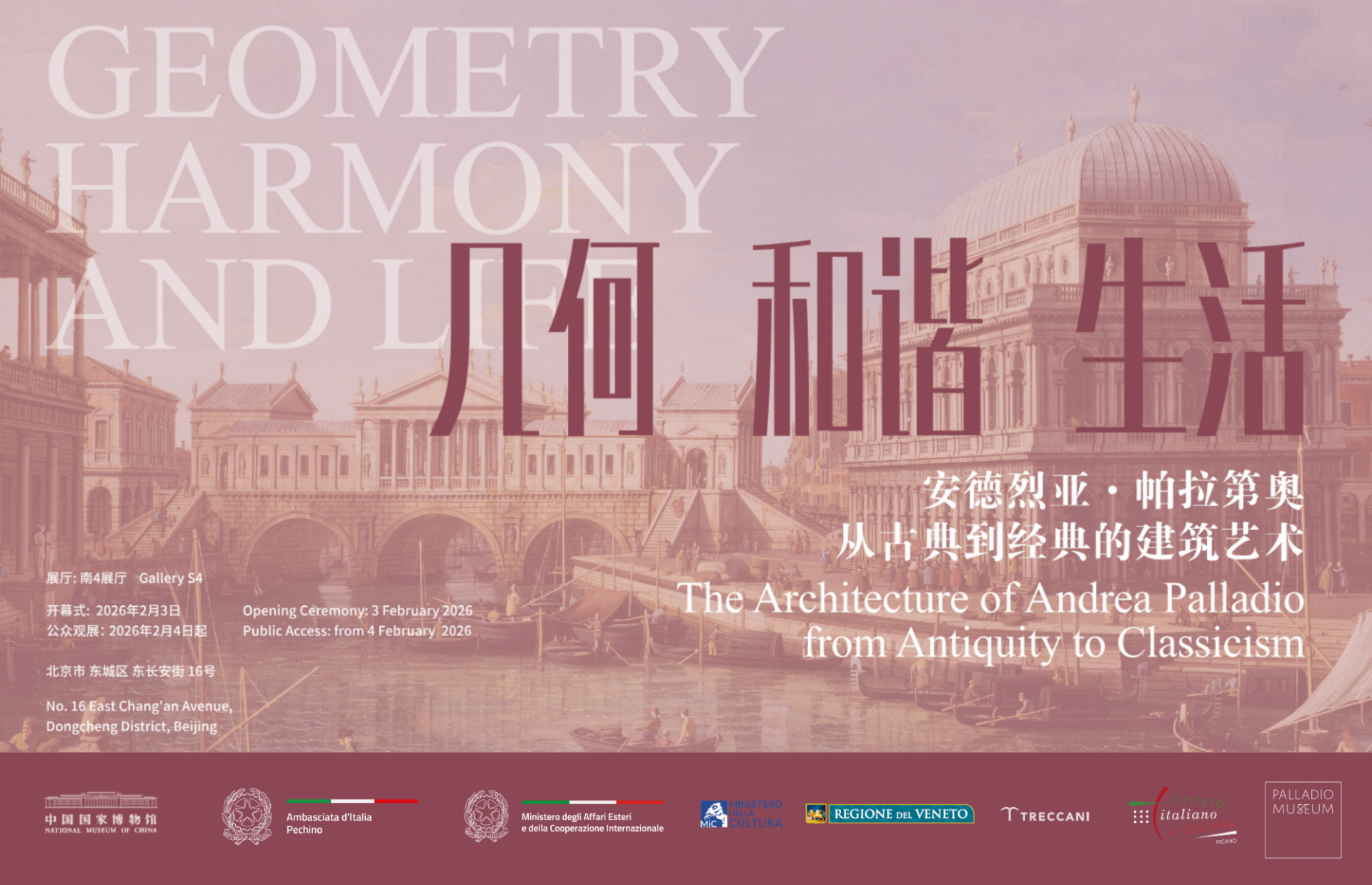
Bringing to a close the celebrations marking the 55th anniversary of diplomatic relations between Italy and China, the Embassy of Italy in Beijing and the Italian Cultural Institute of Beijing have organised the first major exhibition ever held in Asia dedicated to the architecture of Andrea Palladio.
The exhibition Geometry, Harmony and Life. The architecture of Andrea Palladio from the Ancient to the Classical (on view until 15 May 2026 at the National Museum of China) presents Palladio’s architectural legacy through a scholarly project led by leading Italian cultural and academic institutions: the International Centre for the Study of Andrea Palladio’s Architecture / Palladio Museum in Vicenza and the Istituto della Enciclopedia Italiana Treccani, in collaboration with the Politecnico di Torino. As part of the initiative, a first cooperation agreement has also been finalised with the Associazione Dimore Storiche Italiane (ADSI).
The exhibition offers a new perspective on Palladio as an architect of his time, displaying drawings and models of his works alongside bridges, ancient maps, sketches, agricultural tools and images of urban and rural life. In addition to the Palladio Museum, lending institutions include the Civic Museums and the Bertoliana Library of Vicenza, the Civic Museums of Bassano del Grappa, the Monumental Complex of the Pilotta in Parma—featuring Canaletto’s renowned Capriccio with Palladian Buildings—and the National Library of China.
Works from the collections of the National Museum of China further enrich the exhibition, highlighting significant affinities between Eastern and Western architectural thought. Within this symbolic dialogue, the Yingzao Fashi (Treatise on Architectural Methods) is ideally juxtaposed with Palladio’s celebrated treatise The Four Books of Architecture, published in Venice in 1570. Exceptionally, the exhibition presents the copy of The Four Books brought to China by Matteo Ricci in the early seventeenth century and preserved ever since at the National Library in Beijing.