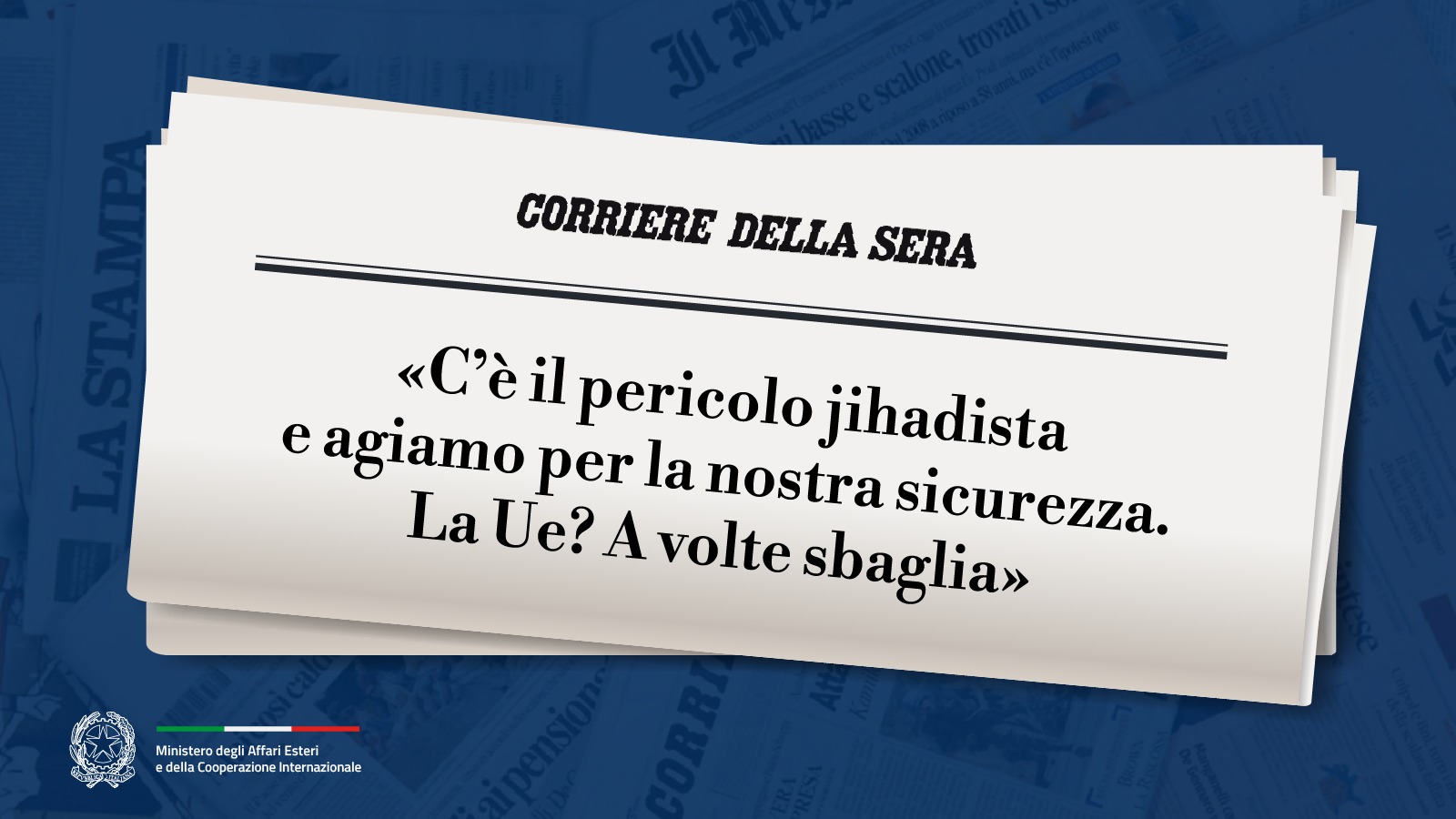
The rivalry with the Spanish Prime Minister “has nothing to do” with the decision to extend the suspension of the Schengen arrangements. According to Foreign Minister and deputy Prime Minister Tajani, this is not an electoral issue but a matter of domestic security: “The jihadist threat must not be underestimated.”
Minister Tajani, have you decided to continue your tug-of-war with Prime Minister Sánchez because he is a socialist and you are in the middle of an election campaign?
“Absolutely not. Our priority is domestic security. The extension was decided following a careful assessment by the Immigration and Border Security Analysis Committee, and its purpose is to prevent terrorism and combat irregular immigration. That is what concerns us—not Prime Minister Sánchez’s political views. Italy is taking action within a framework of European solidarity, including with Spain.”
Do you have any worrying figures? Of the 180,000 people checked, only a few dozen were refused entry, and very few of them were Moroccan.
“Over the past month, 31 refusal-of-entry orders have been issued at maritime and airport border crossings, eight of them involving Moroccan nationals. Six people were arrested. Those are not insignificant numbers.”
So is “the extension is necessary”, as Minister Piantedosi says?
“Absolutely. But it is temporary and is not directed against anyone; its purpose is to protect our security. I would also point out that we have reduced irregular immigration into our country by over 60 per cent.”
So there is no immigration emergency?
“The emergency in Ceuta is not something we invented. Almost 100,000 people arrived, the police opened fire, and we do not know how many people are still there.”
In Iceland, the ‘No’ side won the vote on Europe. Apart from fishing, what is keeping Icelanders away from the European Union?
“Iceland is part of the Schengen area and the internal market. Fishing is an important issue, but it is not enough to explain the outcome. The point is that European policies are sometimes inadequate.”
Which policies?
“Forza Italia does not believe in a Europe bound by red tape and excessive constraints and restrictions. Policies affecting the real economy—in industry, agriculture and fisheries—have sometimes been misguided: too bureaucratic, too restrictive and too closely tied to an ideological view of climate change.”
Are you denying the problem, even after a scorching summer?
“I have never denied climate change, but it needs to be tackled pragmatically, without fanaticism, while respecting our commercial and industrial vocation. The EU is at a crossroads and needs to reform itself. It needs to complete the capital and energy single markets, the banking union and tax harmonisation.”
Is von der Leyen’s leadership still secure, or is she part of the problem?
“Europe needs strong leaders, but this also requires institutional reform. To ensure strong leadership, the Presidencies of the Commission and the European Council should coincide. The use of unanimity voting must also be restricted.”
Prime Minister Meloni opposes that.
“I say what I think, and I will try to persuade the Prime Minister of the merits of my proposals. In areas where unanimity is not required, we managed to reach the Mercosur agreement, which has boosted our exports.”
Could it be that Trump’s campaign to weaken the EU is bearing fruit?
“The fate of the EU is not for the United States to decide, but the Union must become politically stronger. It needs its own defence capability and a more assertive foreign policy, and it must find the courage to become a global player.”
If Le Pen were to win in France, could Prime Minister Meloni move even further towards the sovereignist right and away from the EU?
“Prime Minister Meloni is right-wing, not far-right. If this government were Eurosceptic, we would not be part of it.”
Will Prime Minister Meloni skip the UN General Assembly in September?
“The Prime Minister will decide; she has always attended in the past. What matters is that Italy should be represented at the highest level. I am also deputy Prime Minister, and I will be going to the United Nations. We already have a series of meetings scheduled on Hormuz, the Balkans, fertilisers and other issues.”
Does the relationship between the Prime Minister and President Trump remain frozen?
“Our relationship with the United States is traditional and fundamental to our foreign policy—a guiding star. We remain allies regardless of who is at the White House, but this is not a relationship between master and subject. When we disagree, we speak frankly, as we have done over Greenland, the Pope and Iran. Our cooperation with the United States is substantial. On 21 September, I will sign the critical-minerals agreement with Secretary of State Rubio in New York.”
Is the proposal for a run-off in the electoral law a move driven by fear, aimed at stopping Vannacci? Will you manage to adopt it, or could the governing majority fall apart?
“A run-off is one possibility; we shall see. The law is intended solely to ensure stability.”
Yet you have achieved the record for the most stable government under the current electoral law.
“The Senate does not provide the same degree of stability as the Chamber of Deputies, so there is room for improvement. We will reach an agreement on the electoral law, but it is not the only issue on our agenda. Our priorities are an economic package that reduces the tax burden and measures to ease the burden of the energy crisis.”
A burden that is dividing the government: Salvini wants to tax windfall profits, whereas you oppose such a measure. How can the disagreement be resolved?
“We in Forza Italia have a very clear position. The major oil companies must provide a contribution, but that contribution must be agreed with them.”
Do you stand by your description of it as a Soviet-style tax, even though it infuriated the League?
“Yes. It is a tax rooted in communist thinking, and no one else in Europe is introducing one. Companies need to be involved, and markets must not be alarmed. By negotiating with banks, we secured more than €10 billion for the public finances.”