Minister Antonio Tajani, yesterday Parliament approved the Budget. How do you assess it?
“I am satisfied with the Budget, which was drafted in full compliance with the economic and financial constraints that are clear to all. Above all, Italy is no longer subject to the EU infringement procedure, which has helped to restore the country’s credibility. As Forza Italia, we are also satisfied with a number of specific measures”.
Which ones?
“Support for the middle class, through the reduction of the IRPEF personal income tax rate from 35% to 33% for incomes up to €50,000; support for businesses through the hyper-depreciation scheme and the protection of the primary residence, both by excluding it from the ISEE indicator and by limiting increases in taxation on short-term rentals”.
Anything else?
“An agreement has been reached regarding banks and insurance companies. It is right that they make a contribution, but coercive measures that could have unsettled the markets were avoided, and the notion of so-called ‘excess profits’, which do not exist, was set aside: a pragmatic approach ultimately prevailed. In addition, more than €7 billion has been allocated to healthcare, tax relief has been introduced on contractual pay rises and overtime, and the sugar tax and plastic tax have been postponed”.
Looking ahead to next year, the final Budget before the elections, what objectives have you set?
“We aim to extend the reduction in the IRPEF rate to incomes of up to €60,000. We also intend to strengthen the attractiveness of business investment, as this is the only way to achieve growth, increased employment and higher wages. Unemployment is at its lowest level. Employment is rising, the spread is declining, and we have made every effort to increase wages through new contracts for public sector workers, including in schools and the armed forces”.
More generally, Italy appears to be regaining international standing.
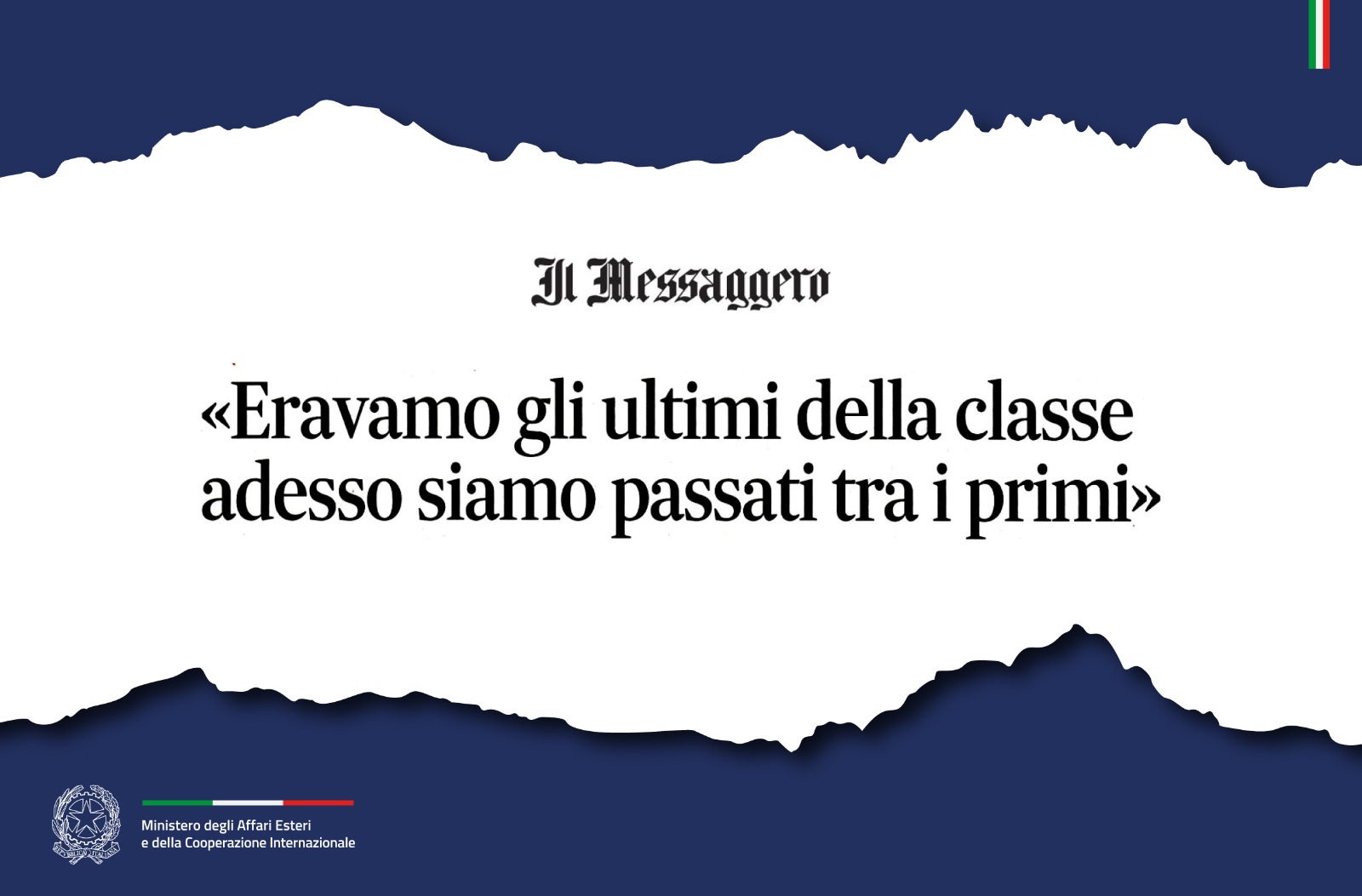
“We have moved from the bottom of the class to among the top performers: the second-largest manufacturing economy in Europe and the world’s fourth-largest trading nation. This is the result of stability and the seriousness of government action: without the time needed to plan, no meaningful progress can be achieved”.
The League appears to continue to show signs of disagreement; Matteo Salvini was not present at the most recent Council of Ministers that approved the Ukraine decree.
“There may be differences, but we are three distinct parties: what matters is reaching a common position. At the last Council of Ministers all League ministers were present; I do not believe that Salvini intended to distance himself from his own government. Ultimately, it is the centre-left that is divided, not us”.
Do you mean that the Democratic Party’s relations with its allies are more problematic?
“Divisions among them are extremely deep, because they are competing on the same political ground, that of the far left. We, by contrast, are focusing on the political centre”.
Regarding the Ukraine decree, do you personally hope it will be the last, at least as far as military assistance is concerned? Are there genuine prospects for peace?
“Italy has always provided support to Ukraine and will continue to do so for as long as necessary: for us, this is a battle for freedom. Naturally, we hope the war will end as soon as possible, which is why we support US-led efforts, even though reaching an agreement will not be easy”.
A 40-kilometre buffer zone in Donbas, as suggested by Minister Crosetto in Il Messaggero: is this a realistic option?
“The key issues undoubtedly concern Donbas and Zaporizhzhia. There are a number of options under discussion, although it is difficult to assess which are realistically feasible”.
In Gaza, at least, the ceasefire appears to be holding.
“The priority now is to move to phase two of the ceasefire. Hamas must take a step back, and Prime Minister Netanyahu must be made to understand that the occupation of the West Bank is not an option. Italy is ready to play its part: to train the Palestinian police force and to support the civilian population, as we have done to date. We have received 1,500 Palestinians in Italy, and together with Minister Bernini we have established humanitarian corridors for students. We are also operating in Sudan, assisting those in need through the delivery of food aid. Italy is a friend of Israel, but we also support the right of the Palestinian people to have their own state. We seek peace, and Hamas represents an obstacle to any sustainable peace process”.
Turning to humanitarian aid, what was your reaction to reports concerning the Genoa investigation into pro-Palestinian associations allegedly financing Hamas?
“It appears that there is compelling evidence, including links with Hamas, financial flows and other elements”.
How do you assess the conduct of certain centre-left politicians who, over the years, have frequently met Hannoun, accused of acting as a point of reference for a Hamas cell in Italy?
“I believe they acted with a degree of irresponsibility”.
Looking ahead politically to 2026, what do you expect?
“We intend to continue our work on the economy and to commit strongly to securing a ‘Yes’ vote in the referendum on justice, which we will actively support. This is a referendum aimed at providing greater safeguards for citizens, not a vote on the government”.
Has the lesson of the 2016 referendum under Matteo Renzi been learned?
“Absolutely. There was no intention whatsoever to turn the referendum on justice into a vote on the government. There is also the issue of electoral reform: a proportional system, modelled on the regional level, with a majority bonus”.
Will you proceed even if the centre-left does not agree?
“The matter will be discussed; no one intends to exclude the centre-left. However, reform is necessary, particularly in light of the reduction in the number of Members of Parliament, as a proportional system would ensure better territorial representation”.
You have described Forza Italia as a centrist party. There appears to be considerable movement at the centre of the centre-left. Are you concerned?
“The centre of the centre-left does not, in fact, exist. Where is it? I see no major political projects. Forza Italia, by contrast, seeks to bring together liberal, popular and centrist forces”.
Your next move?
“Three events in Rome, Milan and Naples in January, marking the anniversary of Silvio Berlusconi’s entry into politics. They will focus on the theme of freedom: justice, freedom from poverty and freedom of enterprise. Carlo Calenda will attend the Milan event, while Maurizio Turco, Secretary of the Radical Party, will be present in Rome”.
Are there any further political convergences under way?
“We share many common positions with Carlo Calenda and would like to work towards an agreement on civic candidates for the municipal elections in Milan, Turin and Rome”.
The inevitable question: there is frequent speculation about the Berlusconi brothers’ involvement in politics.
“They are highly respected figures and close friends. We would be pleased if they chose to enter politics. Their advice is always valuable, and the bond between Forza Italia and the Berlusconi family is indissoluble”.