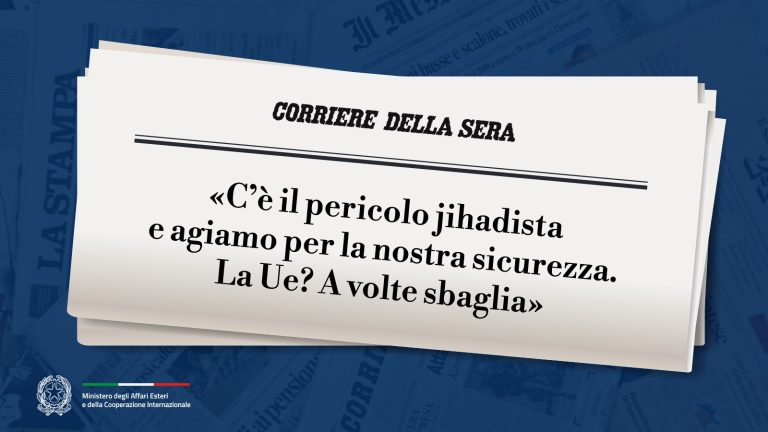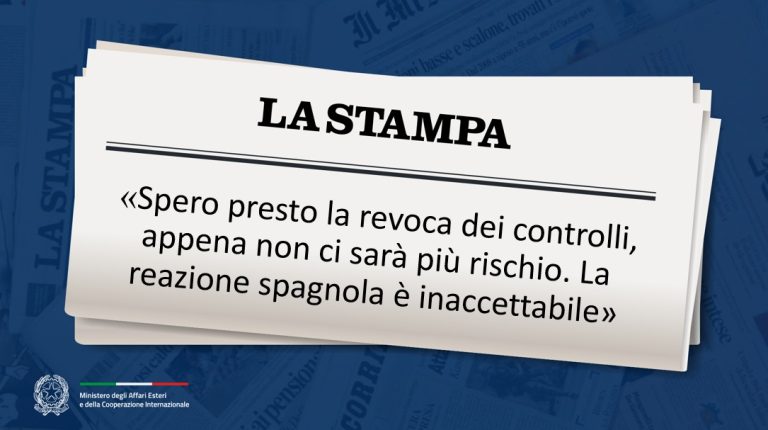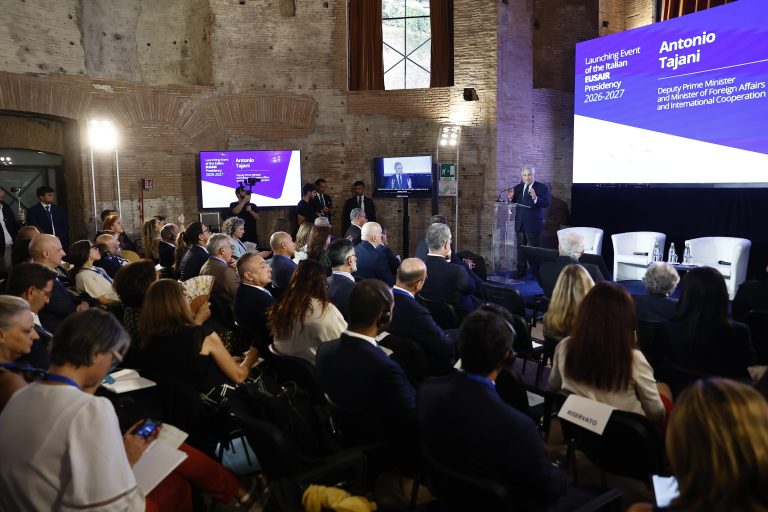
Minister Tajani, what is the aim of all this fuss?
“We haven’t made a fuss. We have suspended Schengen, as provided for in the Treaties, because something extraordinary happened in Ceuta. Even today, Mayor Vivas says that between 8,000 and 11,000 migrants remain there. And thousands of them are sub-Saharan Africans who cannot be repatriated. Rather, what is incomprehensible and utterly unacceptable is Spain’s reaction.”
Ceuta is not part of the Schengen Area – that is the point. The measure is purely symbolic. “Not at all. Ceuta is not part of the Schengen Area but is a Spanish exclave; Spain, however, is part of it. And the risk, as the Spanish press also points out, lies in the secondary movements of non-Moroccans. Where do they go once they have arrived in Spain? Italy, as a destination, is the country most at risk. We are not Germany or Norway.”
I can’t see all these movements…
“Around fifteen irregular migrants have already been detained in Italy. Not to mention that among the migrants were some who had previously been deported for jihadism.”
According to figures from the Italian Ministry of the Interior, none of them come from there.
“They are not Moroccans, but that does not change the nature of the problem.”
Well, I suppose so.
“We need to set the record straight: we are not against Spain, but we have a duty to protect our borders. And there is no doubt that arrivals from sub-Saharan Africa pose a jihadist threat. The Spanish police themselves have detained suspects.”
Brunner, Commissioner for Internal Affairs and Migration, said: “The suspension requires that there be a need for it and that it be proportionate to the facts.”
“Brunner has just reminded Spain of its responsibilities, because the way they are handling this crisis must take into account the need to prevent unchecked migrants from entering the European Union.”
And what about the proportion in the reaction?
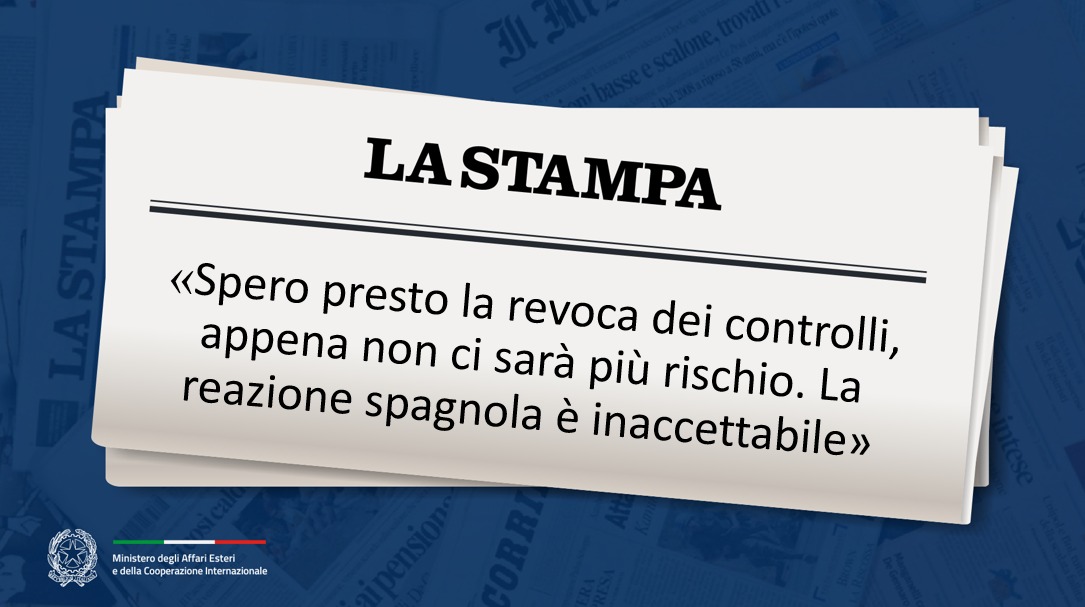
“We have taken this decision for ports and airports, and it concerns third-country nationals. According to Spanish intelligence, there is a risk of a new wave by mid-August: not lifting the measure is a precaution. We hope to be able to lift the suspension soon, as soon as the risk has passed. It is Sánchez who has dramatised the situation.”
But are there any contacts with the Spanish government at the moment?
“You see, how easy it is to make a big deal out of things? Of course! It’s not as if we’ve severed diplomatic ties… But you don’t revoke the Schengen Agreement just as a retaliatory measure, for no reason, causing damage to tourism. Can’t we instead say that something has gone wrong, given the images from Ceuta and the 100,000 people fleeing Morocco?”
Spain has been praised by other European countries for the way it has handled the crisis.
“It did not exercise the necessary vigilance. And the policy of ‘come one, come all, and you will be regularised’ – as it did with a million migrants – sends out a negative message that jeopardises everyone’s safety. It seems to me that this concern is shared across Europe.”
In the face of a crisis, should not the principle of European solidarity kick in?
“Defending our borders does not mean putting Europe at risk, which is what happens with indiscriminate reception.”
Let’s be honest: by lashing out at Sánchez, Meloni sent a message to Trump, one to Vox, and one to Vannacci.
“I gave an interview to ‘Il Mondo’ warning of the dangers posed by the one million people granted legal status, before the Ceuta incident took place. It was the Monday after the World Cup final. I repeat: as soon as the danger has passed, we will reopen.”
Mattarella says: the management of migrant flows must respect people’s dignity. Does this apply to you?
“A powerful appeal that we fully endorse. We are in favour of promoting legal immigration that benefits our economy. But people’s dignity is not respected by handing migrants over to human traffickers, condemning them to death at sea, or offering them a reception that offers no prospect of integration. Our approach is that of Berlusconi: agreements with countries of origin, on-the-ground training, legal migration channels, and integration.”
Why don’t you champion a framework agreement between the EU, the African Union and the United Nations?
“We must forge development and cooperation agreements in Africa, as we are doing, because part of our future in strategic sectors – from immigration to energy – lies there. This is what the Mattei Plan is all about. And the stabilisation of the Mediterranean is crucial to our security.”
You hosted the Lebanon-Israel talks. What, in practical terms, did they achieve?
“The fact that they are talking to one another is already a huge step forward. Rome has become the capital of peace. And Italy is at the forefront of efforts to facilitate stabilisation in the Middle East.”
Netanyahu has absolutely no intention of leaving Lebanon.
“Every war ends in peace. And the processes that ultimately lead to an armistice or an agreement are invisible. We work, in silence, towards this.”
Why don’t you recognise the State of Palestine? The Vatican did so, even before Sánchez… “We have always supported the Two-State Solution, but the Palestinian state cannot be the state of Hamas, a terrorist organisation that triggered the war by carrying out the massacres of 7 October.”
Would you join the Board of Peace again?
“We went there as observers, because anything that can promote peace is worthwhile. That said, nobody has a magic wand, and phase 2 of the Sharm agreements is complicated. Just as complicated is the situation in Ukraine, which we continue to defend whilst the left pursues an ambiguous foreign policy towards Europe and the West.”
It’s easy here.
“It is remarkable that, following Conte’s pro-Russian and anti-Western remarks, Schlein has still not made it clear where she stands. How can someone who lacks a clear foreign policy and dithers for fear of splitting her own party stand as a candidate to govern a country like Italy?”
The election campaign has begun. What will you be doing in the final year of this parliamentary term?
“Above all, we will work to ensure that Italians can enjoy a better quality of life. We have achieved results: 1.2 million more jobs, tax cuts totalling EUR 33 billion for households and businesses, ever-new export records, and a low spread. We can now work to further reduce the tax burden. We will bring our ideas to the coalition table.”
Which ones?
“Abolition of vehicle tax for cars and mopeds, a reduction in tax on thirteen monthly salary, and a flat tax that rewards those who earn more – to start with.”
Where is the money?
“A portion of the funds held in pension institutions and private savings – over EUR 1,700 billion– can be profitably invested in infrastructure and major projects, thereby freeing up public resources to reduce taxes.”
Electoral law. Has he given in?
“A compromise has been reached that ensures compliance with all constitutional constraints. Preferences are not the key element of the law. The aim is to bring stability to the system and the country, which is of great political and economic value for growth.”
What if there were a problem with the secret ballot?
“It won’t happen. It would be suicide.”