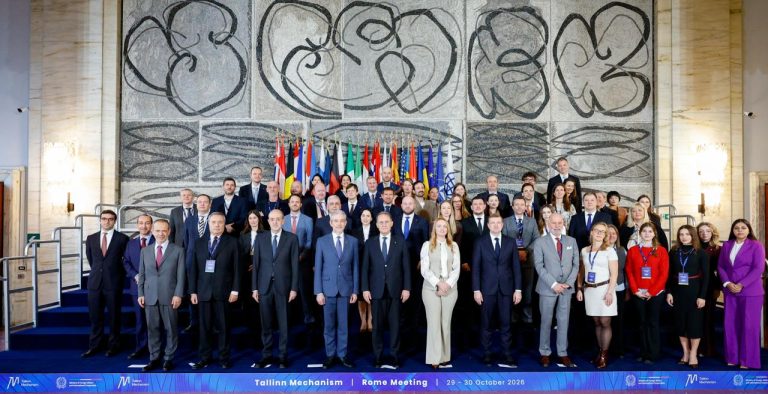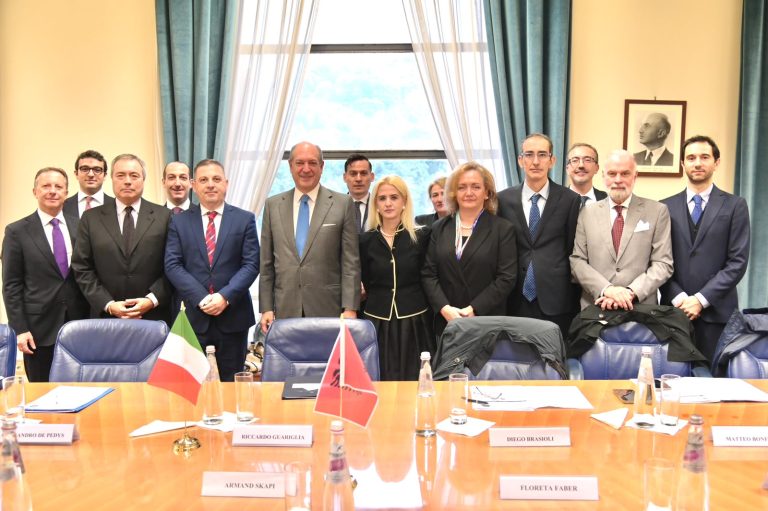
Tallinn Mechanism Member States and Observers met in Rome from October 29 to 30 for their biannual meeting under the Italian Chairship. Launched in 2023, the Tallinn Mechanism has become the leading international platform for coordinating civilian cyber support to Ukraine. It unites member states, observers, donors and technical experts to deliver timely, targeted assistance aligned with Ukraine’s most urgent civilian cyber and digital resilience needs.
Italian Deputy Minister of Foreign Affairs, Edmondo Cirielli, Ukrainian Deputy Minister of Foreign Affairs, Andrii Droniuk, and the Deputy Minister of Digital Transformation, Olha Krevska, delivered opening remarks.
The meeting provided an important opportunity to reaffirm the unwavering commitment of all Member States and Observers to support Ukraine’s civilian cyber resilience for a more solid digital infrastructure and for the benefit of all its citizens, as the country continues to defend itself against Russia’s illegal, unprovoked and unjustified war of aggression, whose consequences affect any sector. In 2026, an additional 32.4 mln € have been allocated to fund concrete projects within the Tallinn Mechanism. This adds to the substantial civilian cyber support already coordinated through the Mechanism since its launch, reflecting continued growth in international efforts to counter Russia’s ongoing aggression and hybrid activities and to bolster Ukraine’s national resilience.
Discussions highlighted the common endeavour of all Member States and Observers to constantly improve the efficiency and effectiveness of the Mechanism, particularly concerning the implementation of projects. With this regard, the importance of public-private partnership was underlined, and several companies and other implementers were invited to share their experience, lessons learned and expectations for the future. Building on the Tallinn Mechanism’s private sector engagement platform, partners are working to deepen cooperation between industry and donor states, including pro‑bono services and discounted goods and services, and to strengthen collaboration with Ukrainian private sector actors. Member States and Observers expressed their appreciation for the private sector’s contribution to the success of this collective effort to advance Ukraine’s broader recovery and reconstruction, to enhance shared cyber resilience and help build a better future for the country and its people.
Furthermore, taking into account the vulnerabilities and challenges faced by local Ukrainian institutions in coping with the consequences of cyber-attacks targeting their ICT infrastructures, a session was dedicated to examples of projects implemented in Ternopil’ and Odesa. These projects help local authorities detect, withstand and recover from malicious cyber activity against civilian infrastructure. Member States and Observers were invited to support additional regional‑level projects, recognizing that strengthening resilience at municipal and regional level is vital for the daily lives of Ukrainian citizens.
Spain was welcomed as the 15th Member State and Japan as a new Observer, while other 8 countries, upon invitation of the Italian Chairship, participated for the first time in a meeting of the Tallinn Mechanism, expressing their interest for a possible future membership. That is a renewed sign of the attention paid by the international community for the key role of the Mechanism within the framework of the multifaceted activities of cooperation and partnership with Ukraine, as well as of the capability of the Mechanism to attract many countries willing to provide their concrete support to Ukraine’s cyber resilience.
As the world faces a new era of hybrid threats, the Tallinn Mechanism stands with Ukraine as a symbol of unity, resilience and shared security. By supporting Ukraine in its defence of civilian cyberspace and digital borders as part of the international commitment to Ukraine’s recovery and reconstruction, partners are also defending the integrity of democratic systems and the safety of citizens across the globe.
Looking to the future, Norway and Finland were announced as the joint Lead Nations for the first semester 2027, ensuring continuity and further strengthening coordinated civilian cyber support to Ukraine.