Minister Tajani, following the attack on an Italian fighter jet, the Houthis have stated that they are not at war with Italy, but have reported the presence of Italian forces in the region. Are we at war or not?
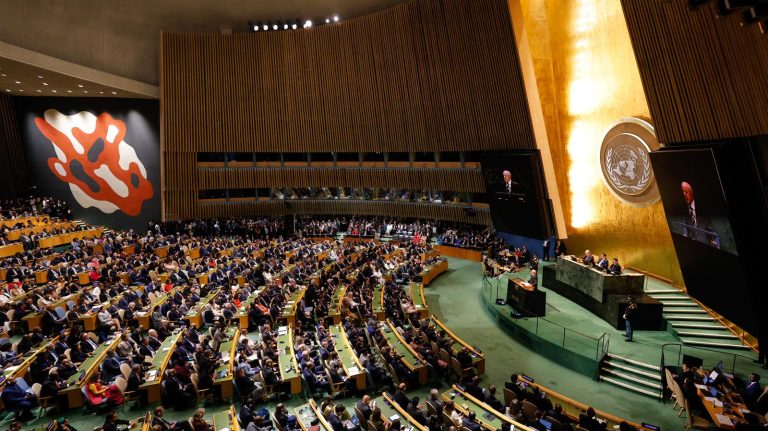
“No, we are not at war. All the more so that the European Aspides mission was established as and remains a defensive mission, aimed solely at ensuring the safe passage of merchant ships transiting the Red Sea and Bab el-Mandeb Strait by protecting them from any Houthi attacks. We will continue supporting the mission in the face of the worsening situation in the Strait, urging the European Union to renew the mission, because we have a strong strategic interest: 40 per cent of Italy’s entire commercial maritime traffic and 60 per cent of the goods we export to Asia pass through the Red Sea. For months we have been calling for Aspides to be strengthened, asking other States to intervene alongside us. I will do so again next week in New York, on the sidelines of the UN General Assembly.” While leaving for the United States for the annual meeting at the UN Headquarters, Foreign Minister Antonio Tajani answered questions from the daily Il Corriere della Sera.
Defence Minister Crosetto said that the enhanced Aspides mission can go ahead even with just our own ships and those of Greece, but added that in this case the costs must be shared by our European allies. Can you confirm this?
“Of course. Either they send more ships or they must bear part of the financial cost. Aspides must absolutely continue and be strengthened.”
Will you be meeting all the EU Foreign Ministers at the UN General Assembly?
“We will hold an ad hoc Foreign Affairs Council meeting. But I will also discuss Aspides at the G7 Foreign Ministers’ meeting and at that of the Rome Coalition for Food Security – a forum launched by Italy and Croatia, which brings together Med 9 (the nine Mediterranean EU countries) and the countries of the Arab League. We have convened it again in New York, expanding the agenda to include freedom and security of navigation. Other meetings are also planned, such as the one with the “Friends of the Balkans.”
You will also be meeting US Secretary of State Marco Rubio. What will you be discussing?
“All the latest international issues. But, first and foremost, we will be signing the agreement on raw materials with Secretary Rubio to make supplies more secure. This also includes the so-called Pax Silica initiative, which was already signed by Ambassadors Varricchio and Fertitta in Brindisi. It is a strategic partnership agreement on critical minerals such as rare earths, aimed at creating an alternative market where China no longer dictates price trends. We have already concluded a similar agreement with Argentina.”
How does this agreement fit in with the overall relationship with the United States and the Trump Administration, with whom there are many other points of friction?
“It is a concrete, mutually beneficial agreement on industrial and trade policy. With the United States, on the issues on which we agree, the dialogue is ongoing and structured. Then, when there are issues on which we disagree, we state this clearly. But America remains our main ally. Take the case of Greenland: we were right to state firmly that we were opposed to any prospect of annexation, and now an agreement has been reached between the United States, Denmark and Greenland. It makes me smile when people say we must become increasingly independent of the United States, yet are then opposed to spending on defence and security. If you want to be a credible partner, you need to be autonomous.”
But the new problems in the Red Sea are down to the United States, which has sparked the war in Iran.
“A conflict we did not support and where we are advocates of peace. In New York, despite our highly critical stance towards Iran – particularly on the issue of military nuclear programmes – I will also be meeting the Iranian Foreign Minister.”
What do you think of Ursula von der Leyen’s proposal to make Canada the EU’s first associate country?
“It seems obvious to me. Canada is part of NATO and the G7; it is a strategic partner for Europe, and therefore I am not at all surprised. We will then look at the details and the practical procedures, but the idea is neither strange nor worrying.”
President Trump, however, sees it as a hostile act towards America.
“That is not how I see it. Canada is a traditional ally of the United States. It is not a conflict – however significant – that can erase this geopolitical reality. As far as we are concerned, our partnership with Canada would have no anti-American connotation or function.”
What will you be discussing in your speech on behalf of Italy at the Plenary Assembly?
‘It will focus entirely on cyber security, hybrid threats and the use of artificial intelligence, where I will argue for the need to ensure that the human role prevails, as Pope Leo himself has said. But I would like to tell you something else, on a different topic.”
Please go on.
“The AfD organised a conference at the Bundestag in Berlin to mark the 80th anniversary of the Paris Agreement between De Gasperi and Gruber on South Tyrol – an issue with which it has absolutely nothing to do. The promotional poster, however, speaks for itself: it features a map showing South Tyrol as a separate, independent State. In other words, the AfD supports and promotes the secession of South Tyrol from Italy. This is an extremely serious matter, and we will be asking how such a thing can take place within the German Parliament. In any case – and I say this to the sovereigntists in our own country – this confirms once again that Alternative für Deutschland is an anti-Italian party, our country’s worst enemy.”