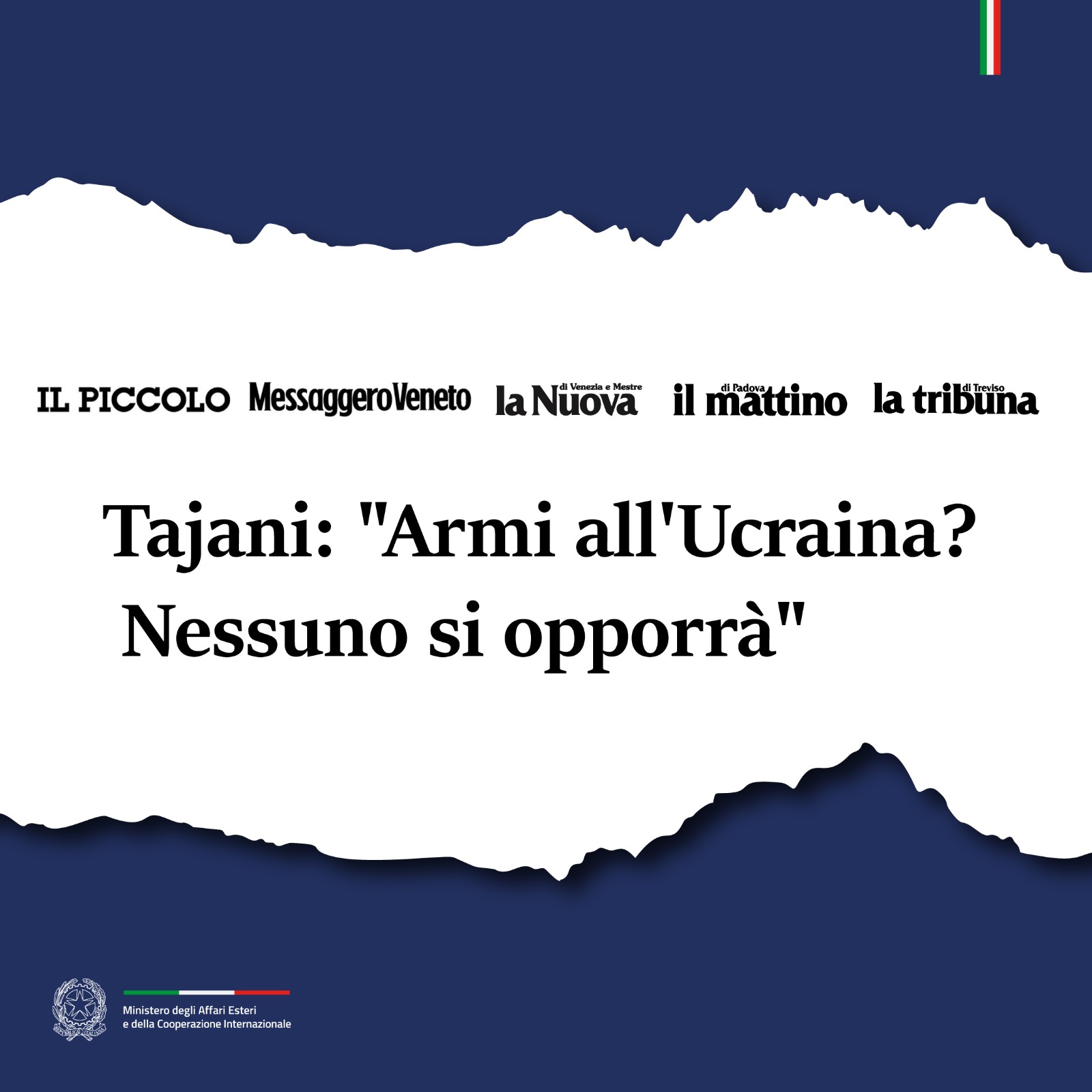
The presence in Veneto of the three centre-right leaders supporting Alberto Stefani, and the League’s threat not to vote for the next decree on sending weapons to Ukraine, are closely connected: it is election season, after all. This, in essence, is the view of Minister of Foreign Affairs, Antonio Tajani, who—using the measured language expected of a diplomat—suggests that such threats made in the middle of an election campaign carry little weight, and that Salvini will ultimately fall into line, as he has always done. And because we are in the midst of campaigning, the Forza Italia leader sidesteps yesterday’s institutional row between Fratelli d’Italia and the Italian Presidency, choosing not to comment. On the issue of Autonomia (the system granting certain Italian regions greater legislative and administrative powers), however, he does not hide his concern regarding the pre-agreements between the State and the Regions, stressing that LEPs (Essential Levels of Services, guaranteeing minimum rights and services to all citizens across Italy) are necessary to ensure equality for all Italian citizens”.
Minister, now that the long cycle of six regional elections has ended, what will change? Could the overall vote share alter the balance of power and shift government policy?
“These elections do not change the national outlook. Our government is solid and functioning very well. I am of course pleased that Forza Italia is growing, which reflects the appreciation for our work. Naturally, if the balance within the coalition evolves, adjustments may follow, but always with mutual respect and the loyalty that defines our alliance”.
If Forza Italia were to overtake the League and become the second-largest party, would you request a reallocation of ministerial posts?
“Absolutely not. There is no need for a reshuffle. The government works perfectly well as it is. I am not interested in positions, but in results. What matters is the ability to shape policy—and my party is doing so: from justice to housing, foreign affairs to the defence of private property, simplification and tax cuts”.
No resources for the housing plan in the budget, yet higher taxes on rentals, fast-track evictions and a pre-election amnesty. What do you agree with, and what not?
“For us, property rights are non-negotiable. We have tabled an amendment to prevent any tax increases on short-term rentals. As for evictions, safeguarding private property and ensuring contractual certainty are legitimate goals. At the same time, shortening procedures excessively risks leaving families who are involuntarily in arrears without alternatives. We must find the right balance. Funds for the Housing Plan do exist. Housing policy remains a priority for us. As for the amnesty, in 2003 Bassolino and the left prevented citizens in Campania from benefiting from it. Today, the alternative cannot be the demolition of thousands of homes”.
Should the League’s move on Differentiated Autonomy before the vote have been avoided? “Differentiated Autonomy is part of the government’s programme and is eagerly awaited in Veneto. We support it, and we will implement it in full compliance with the Constitution and the Court’s rulings. The pre-agreements signed in recent hours are procedural steps; they do not change the substance. LEPs are still required to ensure equality in fundamental rights across the country”.
On resources: will Italy join the EU’s common fund to purchase US weapons?
“Italy continues to support Ukraine with both military and civilian assistance. We are preparing the twelfth package. Concerning military aid offered through the United States, the matter is complex: we need clarity on details, mechanisms and financial coverage. We already have major commitments, having reached 2% of GDP in NATO defence spending. Any decision must respect budget constraints and be discussed calmly with our American allies. There is no pressure—only constructive dialogue”.
When the renewal of military aid to Ukraine goes to a vote, the League’s support is not guaranteed. What happens if they vote against it? “The government holds a united position, also confirmed by the Supreme Defence Council: full support for Ukraine. This is the majority’s line and has been reaffirmed repeatedly. It is normal for coalitions to contain different sensitivities, but responsibility always prevails. We have approved eleven aid packages together; the twelfth has already been set out. Supporting Ukraine means defending international law and our own security. This is not warmongering; it is preventing a larger country from invading a smaller one. That is a matter of principle. Parliamentary democracies naturally have internal debates—even heated ones. It happens in Germany, France, everywhere. What matters is that a clear line ultimately prevails—and it does: Atlanticism, Europeanism, support for international law”.
Do you agree with those who fear Europe would collapse if Ukraine falls?
“If Ukraine falls, Europe is in danger. This is not rhetoric—it is geopolitics. It would mean an authoritarian regime can invade a European country and go unpunished. Where would Putin stop? Moldova? The Baltic states? This is why we support Kyiv: out of realism. Europe must become stronger, more autonomous, capable of defending itself”.
How serious is the risk that Italy’s national system suffers economic damage from hybrid warfare conducted by foreign powers using AI-driven tools? Are we adequately protected?
“The hybrid threat is real and serious. We know that Russia, China and other hostile actors use cyber-attacks, disinformation and sabotage. Italy has raised its alert level, particularly for critical infrastructure. Our intelligence services work effectively and coordinate with our allies. We do not want to fuel unnecessary alarm, but vigilance is at its highest. We are investing in cyber-security, network protection and counter-disinformation. The alert level is appropriate to the threat: high, but managed with competence and discretion”.
Final question: why has Trentini not yet been released, unlike the French prisoner?
“The Trentini case is extremely important to us, and we are working tirelessly for his release. Situations vary from country to country: in Iran, for example, Cecilia Sala and Alessia Piperno were released quickly, whereas some French hostages were freed only after years. With Venezuela, the situation is more complex. But we are not giving up. We maintain constant contacts, including through indirect channels. Two other Italians were recently released by the Venezuelan government. Trentini’s case is different, possibly linked to internal matters there. Above all, the international environment is strained by a serious confrontation between Caracas and Washington. Naturally, we do not disclose everything publicly—hostage diplomacy requires discretion. But the Trentini family must know that we are working, and will continue to work: he has not been forgotten”.