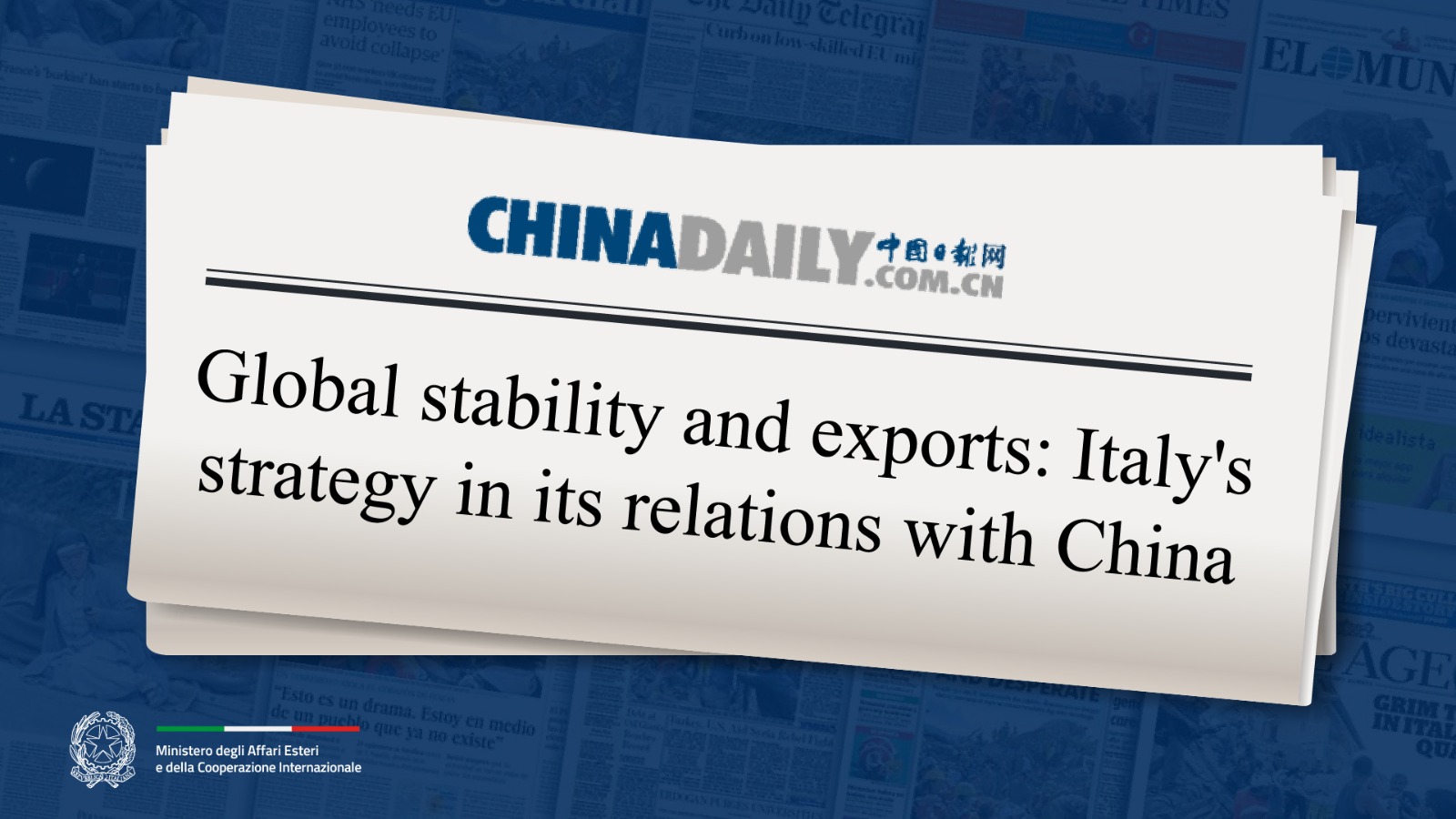
Italy’s international action is grounded in a clear principle: global stability and growth are built through dialogue, mutual respect and tangible cooperation among states. It is within this framework that my third visit to China as Minister of Foreign Affairs takes place, marking a significant step in revitalising our bilateral strategic partnership.
In recent months, relations between Italy and China have intensified considerably, supported by visits from the President of the Republic and the Prime Minister, as well as numerous government missions. This momentum reflects a shared commitment to consolidating a structured, continuous and results-oriented dialogue, as reaffirmed by the signing of the three-year Action Plan.
At a time marked by international crises and conflicts, it is essential to maintain frank and constructive engagement with major global actors. Dialogue with China goes beyond the bilateral dimension.
It also — and above all — unfolds within the broader framework of relations between the European Union and Beijing, where clarity, consistency and pragmatism are required. Italy believes that China can play a meaningful role in addressing major global crises, from the conflict in Ukraine to tensions in the Middle East, including the delicate balance related to the security of the Strait of Hormuz.
Beijing’s capacity for influence represents an important factor in fostering sustainable solutions and helping to reduce international uncertainty, with positive effects on the stability of energy markets and global supply chains. These issues were at the center of my discussions with Foreign Minister Wang Yi, in a spirit of pragmatic engagement aimed at identifying concrete areas of convergence.
Alongside the political dimension, the relationship between Italy and China is underpinned by solid and multifaceted economic cooperation.
China is a priority market for Italy’s strategy of expanding into high-potential non-EU countries and is currently Italy’s main trading partner in Asia, as well as its second largest among non-European partners. In 2025, bilateral trade reached nearly EUR 75 billion, with growth trends confirmed in the early months of 2026.
Italian exports are increasingly well received in China, where demand for quality and innovation continues to grow, particularly in key sectors such as fashion, machinery, pharmaceuticals and chemicals.
These sectors reflect Italy’s manufacturing excellence and offer significant potential for further development.
For this reason, it is essential to continue along a path towards a more balanced economic relationship, promoting fairer and more transparent market access conditions. In this regard, the Joint Economic Commission, which I co-chaired with Minister of Commerce Wang Wentao, represents a key instrument for addressing outstanding issues in a structured manner.
We will continue working with the Chinese authorities to reduce non-tariff barriers, particularly in the agri-food sector, strengthen the protection of intellectual property and improve operating conditions for foreign companies, including access to public procurement. At the same time, we aim to further enhance the opportunities offered by the Chinese market through qualified participation in major trade fairs such as CIIE and CIFTIS.
Beyond the economic dimension, relations between Italy and China are rooted in a strong cultural foundation, shaped by deep exchanges between two ancient civilisations that share a leading position in cultural and natural heritage recognised by UNESCO. This richness is reflected in the many exhibitions organised in collaboration with leading Italian cultural institutions, including the Uffizi Galleries, as well as the ongoing exhibition in Beijing dedicated to Andrea Palladio — the first ever held in Asia on the work of the Italian architect.
There is a growing enthusiasm for Italy, also evident in rising tourism flows, increasing interest in our humanistic and scientific traditions and a strong desire to learn our language. Italian language courses offered in over 50 Chinese universities, together with the presence of more than 15,000 Chinese students in our university system, represent a strategic long-term investment. These young people act as a bridge between our societies and contribute to strengthening mutual understanding with lasting effects.
In line with the founding values of the Republic and the guiding principles of our foreign policy, Italy considers engagement with China an essential component of its international action — one that we intend to pursue with balance, clarity and a constructive spirit.
Strengthening Italy’s presence in China means not only seizing opportunities, but also contributing to the development of a more solid and mature relationship. This is an objective we pursue with determination, in the awareness that dialogue and cooperation remain essential tools for addressing the challenges of our time.