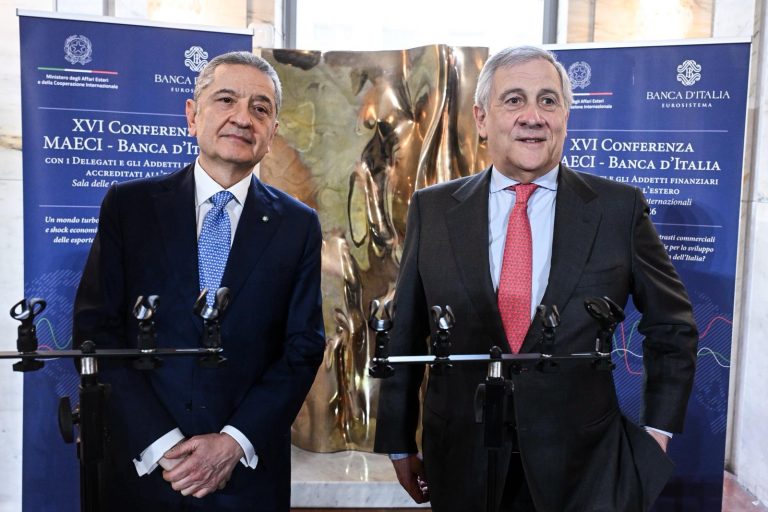
“Trump’s peace plan? It is just a basis, a starting point. We need agreement from Ukraine and the European Union. After all, only the EU can lift sanctions.” The Deputy Prime Minister and Foreign Minister, Antonio Tajani, answered the questions on the conflict in Ukraine by touching a lacquered ivory surface with his fingers. These are the benches of the Subalpine Parliament, where Italy was born, in the heart of Turin. A few meters away from him, by one of those coincidences that seem to make reality the script of a short film, stood Russian director Alexander Sokurov, who has recently received an award at the Turin Film Festival, and has repeatedly denounced his country’s “censorship.” Minister Tajani did not say much about Vladimir Putin: “I do not think he is in a hurry; he probably wants to settle the matter before the coldest winter arrives, but it will still take weeks.” One thing is certain, however: “Peace is between Russians and Ukrainians: Ukraine obviously needs to play a role.”
The visit to the Museum of the Risorgimento, along with his wife Brunella Orecchio, was a pleasure trip, organized by the President of the Piedmont Region (and his deputy in Forza Italia), Alberto Cirio. A few hours at a quick pace to enjoy the beauty of Turin, “an interesting and fascinating city,” after the States General of International Trade organized by his party. Already there, on the sidelines of the meeting, the Deputy Prime Minister had touched upon the subject: “It will be up to the Ukrainians to say what they accept and what they ask to be changed.” But after a quick lunch and the first stop at the Turin Cathedral where the Holy Shroud is kept, the tone became more assertive. Especially regarding the EU’s role: “We cannot think of reaching an agreement without Europe, for the simple reason that Europe has imposed sanctions on Russia – hence without the Union’s agreement, peace cannot be made.” Point 13 of Trump’s plan states: “Russia will be reintegrated into the global economy, with scheduled discussions on lifting sanctions.” Minister Tajani, however, is firm: “It is not Russians that can lift them, only the European Union can do so.”
The Deputy Prime Minister’s approach seems closer to that of Defence Minister Guido Crosetto: “The security issue is important, modelled on NATO’s Article 5, although something more can probably be obtained for Ukraine’s security.” The 28-point plan is “a starting point, not a finishing line, a basis for discussion. Discussions are continuing. Tomorrow (today, ed.) there will be another Summit in Angola and we will see how this proposal develops. We are only at the beginning.”
As the Deputy Prime Minister himself admitted, there was only one moment when he managed to leave “political worries aside.” It was when walking through the 4,000-year history of the Egyptian Museum, amidst the curious visitors in the halls: “I had been there before the transformation, but it is always nice to return to see a place a second time.” The afternoon had begun at the Cathedral: the history of the Holy Shroud, the fascination with the imposing organ, a moment of prayer with his lifelong companion, with whom he descended the stairs, offering her his arm: “Here you feel the existence of God.” An unscheduled ten-minute visit to the Royal Palace, an exchange of words with an usher: “You have a Salerno accent.” The most heartfelt moment, however, was the one linked to his Piedmontese origins; to the Church of the Great Mother of God, the flowers placed on the altar, the gaze at the name of “Mario Testa,” his grandmother’s brother who died at 21 from a war wound: The Foreign Minister said: “If you lose your life in combat, you receive a gold medal; a silver one if it happens later. He died a week after being wounded in the leg. He had volunteered for what became the Arditi; he believed in it, patriotic as only the Piedmontese could be. That young great-uncle was also a Juventus fan, like his grandmother, whom Tajani often mentions: “She played in the youth team.” The rest of his blood is “Ciociaro” (from the area of Ciociaria, Lazio Region). The Deputy Prime Minister searched for his mother’s hometown, Ferentino, on a historical map kept in Palazzo Carignano. There, however, it was difficult to get away from Rome’s political worries. In the dimly lit room, politics was palpable, and his gaze fell on the seat where Cavour sat: “President Trump? He probably wants to achieve peace before the Nobel Prize is awarded. After all, he is a human being and, as such, made up of instincts and psychological levers and drivers.”