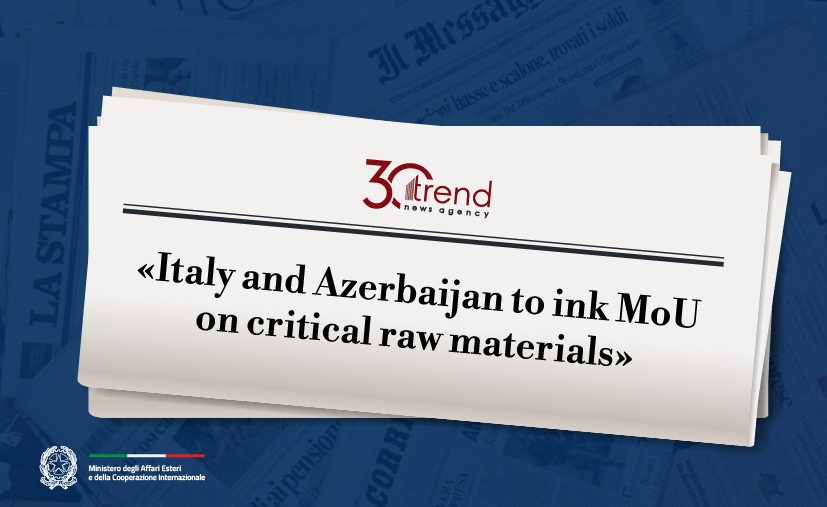
BAKU, Azerbaijan, November 23. Italy and Azerbaijan will sign a Memorandum of Understanding on critical raw materials, Antonio Tajani, Deputy Prime Minister and Minister of Foreign Affairs and International Cooperation of the Italian Republic, said in an exclusive interview with Trend ahead of the Italy-Azerbaijan business forum in Baku.
“Azerbaijan is a close friend and strategic partner for Italy. Our ambition is to unlock the full potential of our economic relations, expanding cooperation well beyond energy. Building on Prime Minister Meloni’s visit to Baku last May, the Business Forum will also focus on new opportunities in critical raw materials, infrastructure, connectivity and logistics, advanced manufacturing and pharmaceuticals. I will sign a Memorandum of Understanding on critical raw materials, aimed at promoting joint initiatives in third countries. Major projects, including the Absheron gas field, SOCAR’s planned refinery in Sumgayit and the modernization of Baku’s transport infrastructure, offer concrete opportunities for Italian companies,” he said.
Potential for further increasing gas imports from Azerbaijan
Tajani noted that Azerbaijan is a reliable and indispensable energy partner, supplying 16% of Italy’s gas imports and 13% of its oil imports in the first half of 2026.
“The TAP pipeline has been instrumental in strengthening our energy security, particularly since 2022. We fully support expanding its capacity to increase supplies to Italy and Europe. SOCAR’s acquisition of Italiana Petroli marks another milestone in our partnership. We also greatly appreciate SOCAR’s voluntary decision to cap fuel prices in Italy during the current Middle East crisis, a tangible gesture of friendship towards Italian families and businesses,” the deputy PM added.
Expanding Italian-Azerbaijani cooperation in renewable energy
He pointed out that the energy transition opens a new chapter in the strategic partnership between Italy and Azerbaijan.
“Italian companies are already working with SOCAR on emissions reduction, biofuels and skills development. We see considerable potential to expand this cooperation into renewable energy generation, transmission infrastructure and innovative technologies. Italy supports feasibility studies for the Green Energy Corridor and the Trans-Caspian Electric Corridor, which could connect Central Asia’s renewable resources to European markets through Azerbaijan. These projects also reinforce the strategic importance of the Black Sea–Adriatic region and the Western Balkans, a key priority of Italian foreign policy,” Tajani explained.
Italy’s view on Middle Corridor’s development
The deputy PM noted that the Middle Corridor is strategically important for Italy, strengthening the country’s connections with Azerbaijan and Central Asia.
“Our growing engagement with the region, including the Italy–Central Asia Summit and Business Forum, reflects this priority. We want Italy to become a leading European and Mediterranean connectivity hub, building on initiatives such as IMEC while actively supporting the Middle Corridor. Our vision encompasses transport, logistics, energy and digital infrastructure, with particular attention to security and resilience. Italian companies have world-class expertise in all these sectors and are ideally positioned to contribute to the Corridor’s development,” he added.
Potential for expanding the presence of Italian businesses in Azerbaijan
“Our economic partnership is growing, with bilateral trade approaching €8 billion in 2025 and Italian exports rising by over 14% in 2026. We want to build on this momentum, encouraging not only trade but also joint ventures, industrial partnerships and two-way investments. Italian companies bring advanced technologies, industrial expertise and a strong tradition of working closely with local partners. Beyond energy and infrastructure, we see promising opportunities in advanced manufacturing, critical raw materials, pharmaceuticals, agribusiness and digital technologies, including through the use of the Alat Free Economic Zone as a platform for Italian businesses seeking to expand across regional markets,” Tajani concluded.