The twenty-two gold medals, the sixty-five total medals of Italian athletes in Birmingham, are not just a sporting fact. “These results,” says Antonio Tajani, Minister of Foreign Affairs, “give a credible image of Italy in the world.”
Minister, they also say something about the Italian way of competing: is it just talent, or is there a system behind it that works?
“There is a system behind these victories. There are federations that have prepared their successes with care and commitment. Behind the medals in athletics, swimming, tennis, there are years of work. The number of podium finishes proves just that. Once we won an important race, maybe with Livio Berruti, now we have many athletes at the top of the world.”
What does this medal table tell us about the new Italy?
“It shows us extraordinary young people who are dedicated, work hard, and achieve results.” Young people who know languages, are humble, and present a positive image of our country. Sara Curtis is a girl who wants to be a psychologist, goes to university, studies in the United States. They are the mirror of their generation. And they are a magnet for Italy.”
A magnet?
“Of course, a magnet. They are attractive and drive the economy. Sports tourism alone is worth 0.5% of GDP, over EUR 10 billion.”
It’s not a small thing…
“And that’s not all. The sports economy generated over 32 billion in value added, representing 1.5 percent of gross domestic product, with year-over-year growth of over 30 percent. There are 421,000 people employed. In 2024, Italy exported “core” sporting goods worth approximately EUR 4.7 billion. At the Paris Olympics, the slopes were built by an Italian company, and skiing in Arab countries is possible thanks to Italian-made snow cannons.”
Speaking of exports. Even in foreign markets, Italian companies are vying for fourth place globally, behind giants like the US, China, and Germany. Are we leading the way in many high-value-added sectors?
“We are achieving extraordinary results in exports. We are doing this because our companies have been able to diversify. We are the world’s fourth-largest trading power, and we have achieved this despite two wars. The French economist Bastiat said that where weapons go, goods do not; we have managed to get them through despite everything. Think about where we would be without conflicts. We wanted to use sports as another tool to help Italian companies establish themselves on the global stage.”
Is foreign policy also shaped through sports?
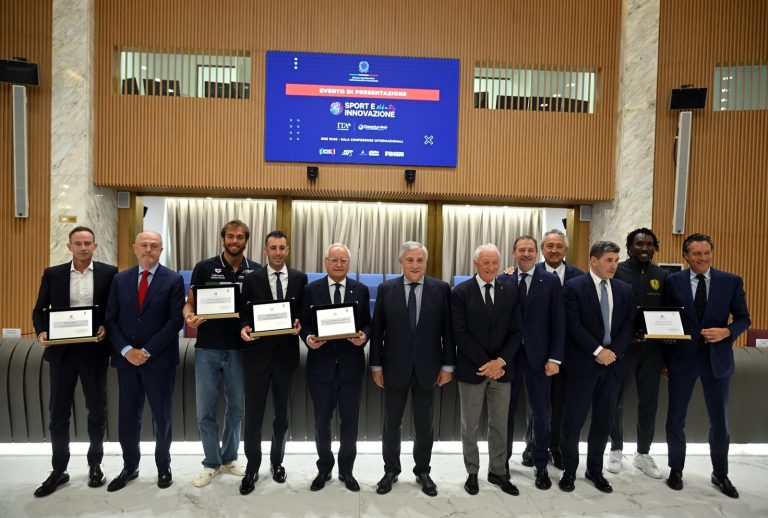
“Foreign policy is also shaped by the actions of our fellow Italians. Achieving outstanding results in sports is an incredible motivator. With the reform of the Ministry of Foreign Affairs, I wanted a special sports office in the Directorate-General dealing with exports.”
Can athletes be ambassadors of Made in Italy?
“It is so true that I decided to appoint some of the winners of the athletics medals Italian ambassadors of sport in the world: Sara Curtis, Chiara Pellacani and Dariya Derkach. I think they can give a beautiful image of our country contributing to its attractiveness.”
The economic contribution of sport to growth is also linked to the international events that a country hosts. Do the successes of Italian athletes in England strengthen the Italian candidacies for the World Athletics Championships and, in the future, for the Olympics?
“Meanwhile we will now have the European Football Championship in 2032. Successes certainly have a bearing, they give credibility. Major international events are capable of generating significant economic and tourist repercussions. For the Olympic and Paralympic Games in Milan – Cortina 2026, the IOC estimated a net economic impact of more than EUR 5 billion. The Giro d’Italia is worth EUR 2.1 billion, the International BNL in Rome generated 900 million in economic impact. As I said, we believe that sport is strategic, we will have a great sporting event in September in Rome dedicated to sport, precisely because we consider it part of a foreign policy strategy.”