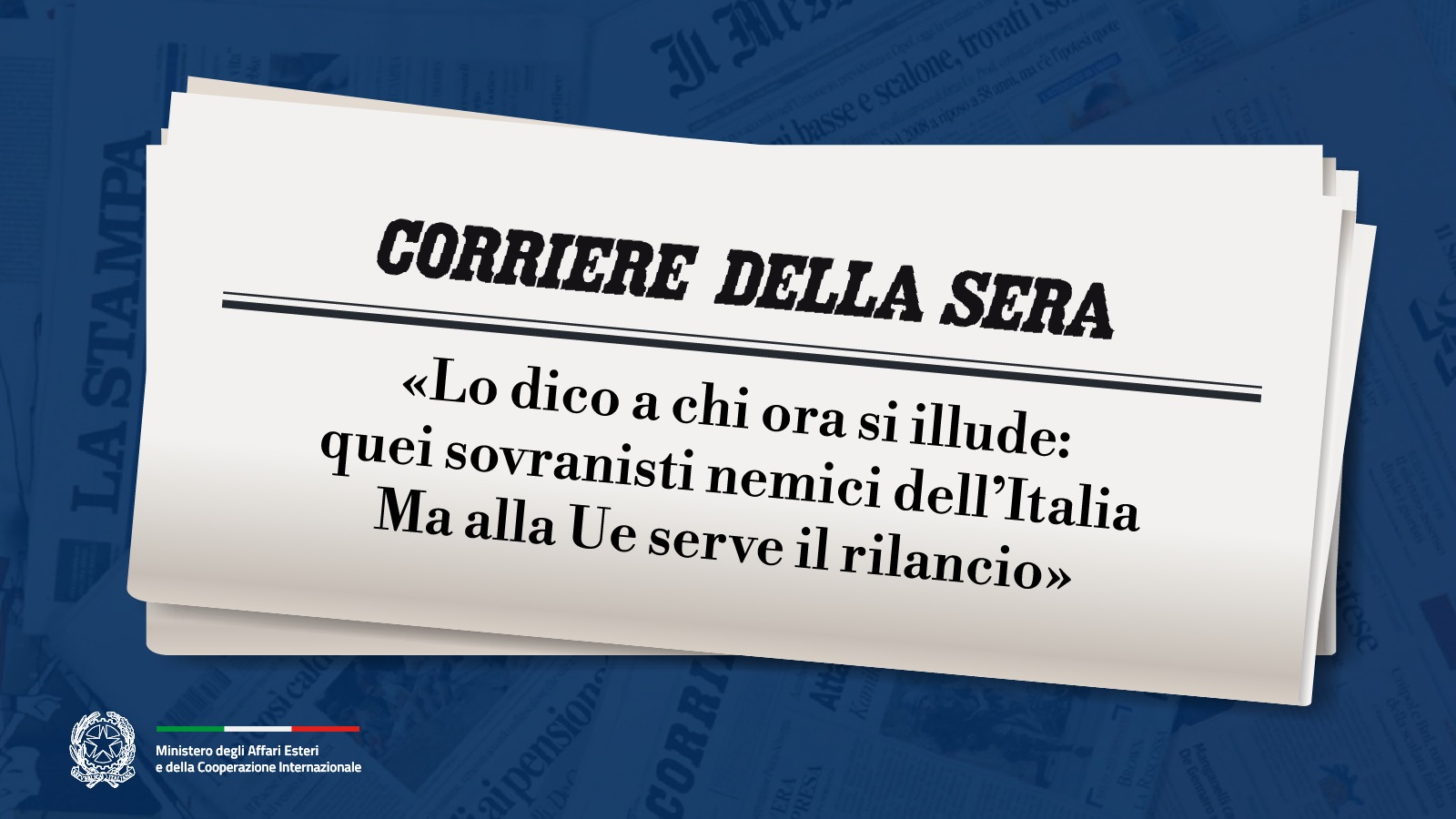
‘I want to say this to those in our country who harbour sovereignist dreams: German sovereignists are Italy’s worst enemies. I recall that at the time of the euro crisis, Alternative für Deutschland (AfD) was founded precisely to take a hard line against Southern countries, and Italy in particular.”
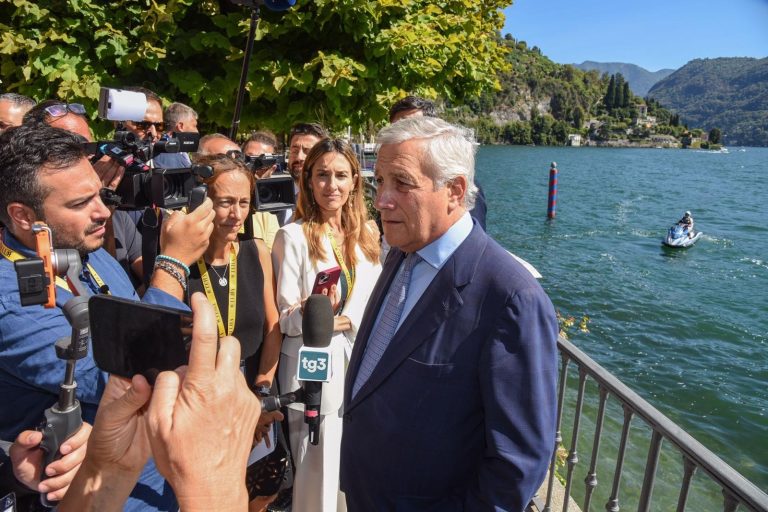
The day after the AfD’s success in the regional elections in Saxony-Anhalt, Foreign Minister Antonio Tajani answered questions from the daily Il Corriere.
You described the AfD’s victory in Saxony-Anhalt as “very bad news”.
“I stand by that. It is a force that runs counter to the liberal and Western values with which Forza Italia identifies. But there are specifically German reasons behind that local success. I do not believe that all Alternative für Deutschland voters are driven by nostalgia. They voted for it for reasons such as immigration, security, the industrial crisis, and rejection of EU bureaucracy, not to mention the damage caused by the communist regime, which has left deep scars.”
Does this mean it is not a signal Italy should take on board?
“In Italy, the situation is different. Unlike in Germany, where the CDU is allied with the Social Democrats, we have a cohesive centre-right government; there are no internal contradictions.”
Well, on the very issue of the AfD, you and Salvini hold diametrically opposed positions. Salvini was over the moon. Is that not a major contradiction?
“I am referring to political homogeneity and uniformity.”
But it is a decisive factor, not least in relation to the things you say about Europe, which are certainly not the same as Salvini’s.
“We and the League are two different parties. Forza Italia is a Christian, liberal, reformist, rights-respecting, pro-European and pro-Atlanticist party. I do not agree with what the League says on these issues, just as I do not agree with what the AfD or the Rassemblement National (RN) say, even though they hold different positions. Let me remind you that within the EU, the AfD and the RN do not see eye to eye and belong to different political groups.”
These do not seem to be marginal issues.
“What matters is the government’s policy line on these issues. The Prime Minister is certainly not anti-European or anti-Atlanticist. If that were the case, we would not be in government.”
What should Europe’s response be?
“The response at European level to the AfD’s success can only be a revitalisation of Europe. Today, there is a lack of a genuine industrial policy, as the Green Deal has put the entire automotive sector in difficulty. Furthermore, the Union must change gear politically. We need to cut through the EU bureaucratic jungle. For every new rule, two old ones must be abolished. We need to complete the single market and carry out a series of institutional reforms, such as the direct election of a single President of the Commission and the Council, the extension of majority voting, and the strengthening of the European Parliament’s role, which must have the power to propose legislation. What I mean is that the response to nationalism needs to combine efficiency with vision, solve problems and inspire European citizens to dream once again.”
However, it does not seem to me that Chancellor Merz and the German government share all your views.
“It is true that the German government takes a different stance on Eurobonds for defence. But on growth, industrial policy and cutting red tape, Italy and Germany are marching in step. Even on majority voting – an issue on which there are differences within our own government – there is agreement between us and the German Christian Democrats. We will soon be making a visit to Berlin to further coordinate our positions.”
Despite the defeat, Chancellor Merz has just reaffirmed the so-called ‘Brandmauer’ – e.g. the exclusion of any possibility of agreement or collaboration with the AfD.
“I agree with that.”
So does this also apply to General Vannacci, who was the most enthusiastic in his congratulations to the AfD, as if they were kindred spirits?
‘The policy of non-cooperation with the AfD stems from a rejection of the values it espouses. That said, every country and every party stand on their own merits; every political force is different.”
But in Italy, it is Vannacci who espouses the AfD’s values.
“The same rejection applies to those values. Incidentally, it is Vannacci who has distanced himself from the coalition and now often votes alongside the left-wing parties.”
But just as the CDU states clearly and unequivocally that it will never form a coalition with the AfD, shouldn’t Forza Italia – which is part of the EPP – say the same thing about Vannacci?
“We say every day that we are not his allies and that there is no possibility of cooperation. But let me say one more thing.”
Please do.
“Vannacci is always criticising the compromises made within the EU. But I was the only one who defeated the left-wing parties in the European Parliament, where I was elected President by a majority of EPP, Liberal and Conservative members. That is precisely the majority we need to build as an alternative to the left-wing parties, capable of bringing about a change of direction for Europe. We cannot allow the national-populists to do this, as they harbour a destructive attitude towards the process of integration. This would mean condemning Europe to marginalisation, to the benefit of America and China.”
When you speak of conservatives – considering that you distinguish them from the AfD – do you also include Marine Le Pen’s Rassemblement National if it were in government?
“I have spoken of conservatives, of whom the RN is not a part. We are far apart on many issues, such as the single energy market that we want to develop but the RN rejects”.
Has immigration been the most powerful driving force behind the AfD?
“They were slow to acknowledge we were right on immigration. The new European pact was a victory for Italy, but it did not have an impact on the election campaign in Germany. We have managed to drastically reduce the number of illegal migrant arrivals; we are down by 80 per cent, as Minister Piantedosi has shown. But there is still a security issue that we need to address, if we do not want the spectre raised by the national-populists to take root.”
How do you see Chancellor Merz’s future?
“I hope he will be able to continue to rule Germany. The CDU-CSU is a source of stability and a point of reference for all Christian Democrats.”