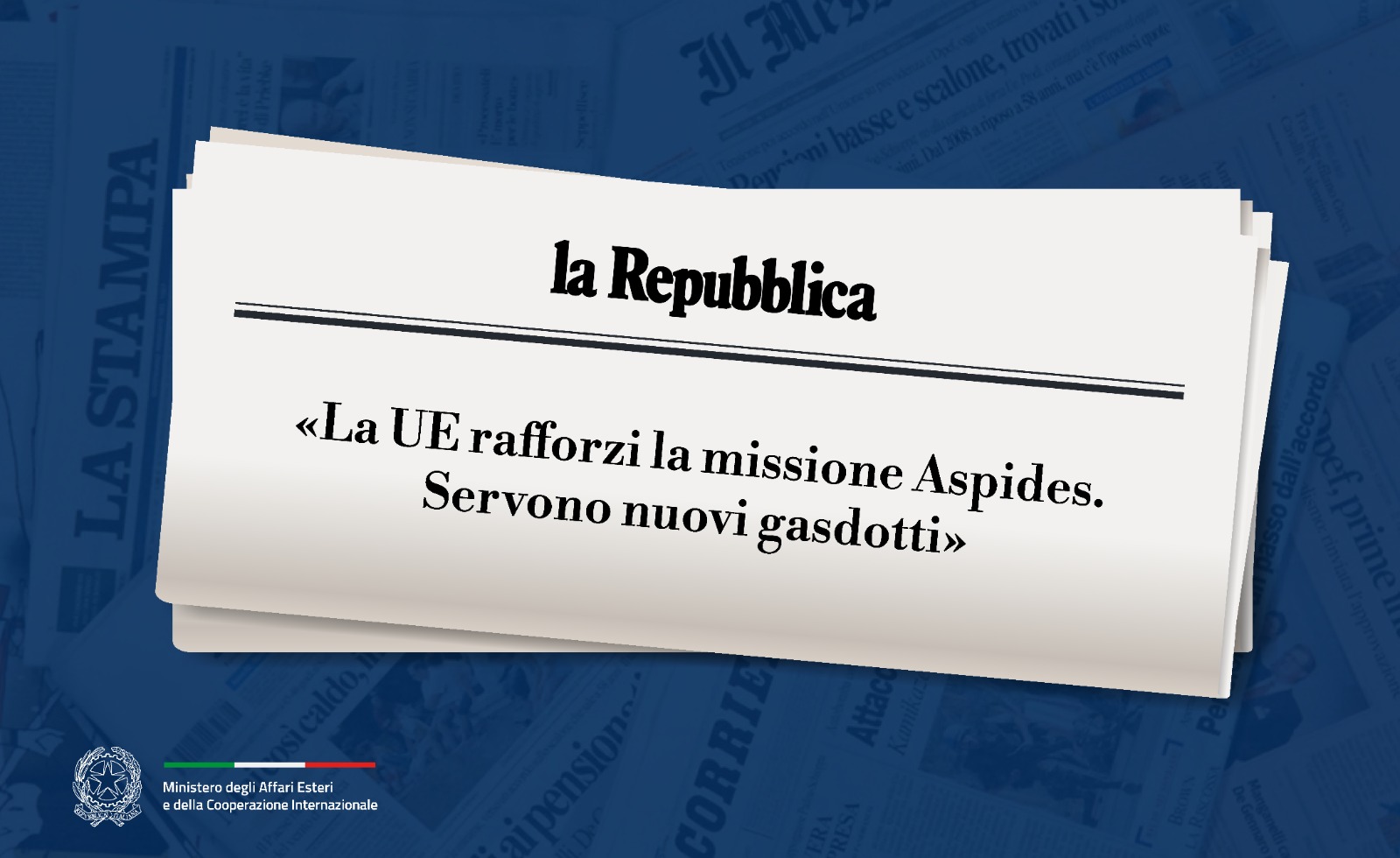
New York – “Europe must strengthen the Aspides mission” to ensure freedom of navigation in the Red Sea, now threatened by the Houthis. The US is also calling on its allies to step up their efforts in the Strait of Hormuz, but “the condition for doing so is an end to the war”. These are the thoughts of the Italian Minister of Foreign Affairs, Antonio Tajani, after attending yesterday’s meeting of the Europe Gulf Forum.
Why did you attend this meeting?
“It’s very important. We must strengthen cooperation between Europe and the Gulf Cooperation Council countries. They are friends and we must work hard together, first and foremost for peace and stability in the region. For Italy it is crucial, because we are the second most important industrial country in Europe and the fourth for trade, so freedom of navigation is essential. That is why we must work hard, all together, on the Red Sea, where we are protecting our ships crossing Suez and Bab el-Mandeb with the European mission Aspides. We need more involvement from other countries”.
How did Europe respond to your requests?
“Following the letter sent by Minister Guido Crosetto, I raised the matter on Monday at the Foreign Affairs Council to seek prompt responses, and I urged the High Representative for Foreign Affairs, Kaja Kallas, to ensure that the Aspides programme is strengthened. The Greeks have also complained, as has the European Commissioner, because only two countries are shouldering the entire burden”.
As an alternative, are you considering building gas pipelines to bring energy from the Gulf directly to Europe?
“Absolutely. We are also working on submarine cables and other infrastructure. The first thing we must do, however, is to restore stability and peace, because if the gas pipelines are bombed, like the oil pipelines, there is a risk of damage. So we must work for peace. The Gulf States are very important sources of energy; they are suppliers, and we also have significant political relations with them. They can talk to Israel, they are Muslim countries that can facilitate dialogue with Palestinians, and in the case of Qatar and Oman, they have also played very important mediation roles”.
Do the other Europeans agree on the need to strengthen cooperation with the Gulf?
“This must be the start of a strategy. This is not just an issue affecting the Mediterranean countries; Finnish President Alexander Stubb and Polish Minister of Foreign Affairs Radosław Sikorski have also spoken about it. The model could be to repeat an agreement like the one reached with Mercosur, taking it as an inspiration for the Gulf countries, in order to strengthen economic and commercial collaboration. The condition, however, is to bring the war to an end, in order to restore peace, stability and freedom of navigation. 40% of Italian maritime trade passes through these routes. These are key energy supply countries, which are also strategically located for interconnection with the India-Middle East-Europe Economic Corridor, the IMEC Corridor. We will be in Saudi Arabia in November. Trieste and Koper could become the Mediterranean hub, and all the ports on the Adriatic will be involved in a project we are working on intensively, for which we have appointed Ambassador Francesco Talò as special envoy. The condition is, however, to rebuild peace and stability. We must explain to Iran that peace is important for them as well”.
The United States is calling on its European allies to do more in the Strait of Hormuz. Is the end of the war still the condition for Italian intervention in this case too?
“Absolutely. We can work and do other things, but it is essential that the war comes to an end”.
In your speech to the General Assembly on Wednesday evening, you supported the interests of Italy and the West but also defended multilateralism and peaceful coexistence based on rules. Yesterday, however, it was reported that, according to the CIA, Russia is preparing to attack Italy with drones from the sea.
“There is no evidence of this. There is no indication that there are any threats of this kind against Italy. It is another matter entirely to say that the Russians are launching attacks through hybrid warfare, cyber security, fake news and attempts to influence elections in European countries – that is certainly the case – but there have been no reports of military attacks”.
Europe is also being shaken by the rise of right-wing parties hostile to the project of European unity, as has happened in Germany. Maurizio Lupi has said that if Vannacci joins the centre-right coalition, his party, ‘Noi Moderati’, will pull out. Would Forza Italia do the same?
“But it is Vannacci who is outside the coalition. He has decided to leave, so the issue does not arise”.